Where AI agents fit across the compliance lifecycle

On this page
Banks could increase productivity up to 20 times with a workforce of AI agents, according to McKinsey. That estimate is based on one compliance professional supervising from 15 to 20 specialized agents instead of completing every task themselves. Compliance teams are already starting to manage people and AI side by side.
AI agents are specialized workers that can take on everything from investigating a screening alert to monitoring a business for changes after onboarding. Each owns a defined job, while people manage their work and step in when judgment is required.
Financial institutions are still working out where those agents fit. Only 10% have adopted AI agents at scale, reports Capgemini Research Institute. Banks see fraud detection (64%) and customer onboarding (59%) as two of the leading use cases for large-scale deployment.
The value of AI agents depends on the roles they’re given.
How AI agents work in compliance operations
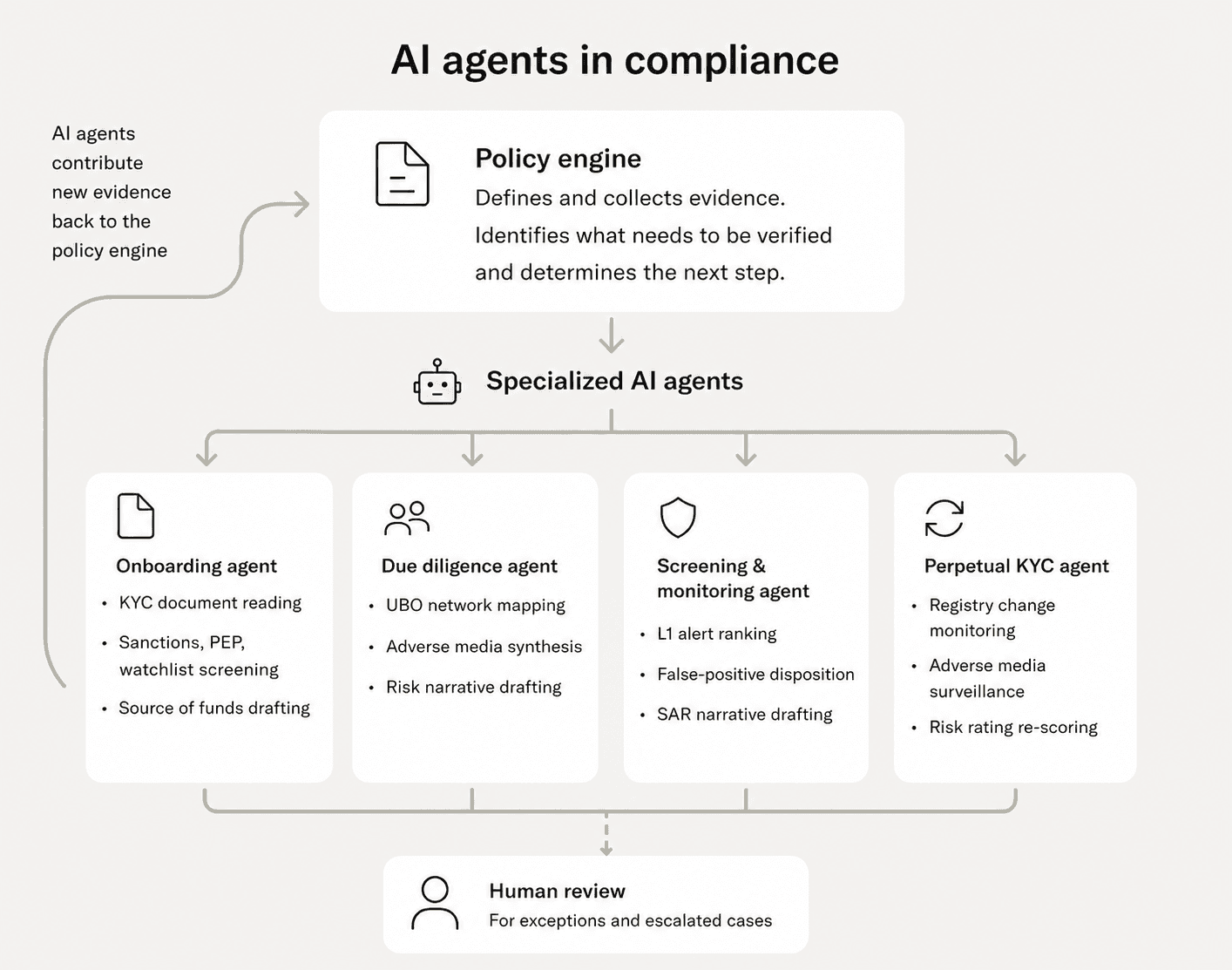
Every AI agent starts with a policy that defines the evidence required for the case.
Duna’s onboarding and compliance platform uses a policy engine to collect as much evidence as possible from business registries, submitted documents, sanctions lists, and other trusted sources. The policy engine then identifies what still needs to be verified and determines the next step. Specialized AI agents take responsibility for completing the remaining work.
Each purpose-built agent is responsible for a specialized part of a complete compliance job within an autonomous system. They collaborate with other AI agents and with human analysts to complete that work in the most efficient way. Here are a few examples.
Onboarding agent: reads Know Your Customer (KYC) documents, performs sanctions, politically exposed person (PEP), and watchlist screening, and drafts source of funds summaries
Due diligence agent: maps ultimate beneficial owner (UBO) networks, synthesizes adverse media findings, and drafts risk narratives
Screening and monitoring agent: ranks Level 1 (L1) alerts, determines false positives, and drafts Suspicious Activity Report (SAR) narratives
Perpetual KYC agent: monitors registry changes, conducts adverse media surveillance, and re-scores customer risk ratings
AI agents contribute new evidence back to the policy engine until the policy is satisfied or the case is escalated for human review.
The compliance journey
The example below traces a German manufacturing company as it applies to open a business account. Specialized AI agents take responsibility for each stage, from onboarding through monitoring.
Onboarding agent: Gathering evidence before review
The onboarding agent prepares the application before an analyst opens the case.
As the company submits its application, the AI agent retrieves company information from the German Handelsregister (G-BRIS), along with the documents provided by the customer. It checks the available evidence against the organization’s policy and determines that one beneficial owner’s identity still needs to be verified before the application can move forward.
Instead of requesting every document on a standard checklist, the agent asks only for the additional evidence needed to satisfy the policy. By the time the application reaches an analyst, the routine verification work is complete and only the open questions remain.
AI agents in Duna helped one European eCommerce platform cut onboarding time from 8 days to less than one minute.
Due diligence agent: Building the risk picture
The company’s ownership structure includes a holding company in Luxembourg, requiring additional investigation before a risk decision can be made. The due diligence agent maps the ownership structure, researches the related entities, and assembles the available evidence into a documented assessment for review.
The compliance professional reviews and confirms the findings before deciding whether or not the business meets risk requirements.
Screening and monitoring agent: Investigating alerts
During onboarding, one of the company’s directors generates a potential sanctions match.
Before the alert reaches a human, the screening and monitoring agent investigates the result using the available evidence. It determines that the match relates to a different individual with the same name, and documents the evidence supporting that conclusion.
The compliance expert reviews the assessment and clears the alert without repeating the underlying investigation.
“We have done more than 20,000 screenings on Duna at speed, because we can see everything in one overview, without pulling sources from multiple systems.”
—Project Lead, CDD, European e-commerce platform
Perpetual KYC agent: Keeping business identity current
Eight months later, the company appoints a new managing director. The perpetual KYC agent detects the registry update and reassesses the case against the organization’s current policy.
If the new evidence changes the assessment, the case is returned to a compliance professional for review. Otherwise, the customer record stays current through continuous monitoring, without requiring a manual reboarding exercise.
Governance keeps agents on track
One of the biggest misconceptions about AI agents is that deploying them is simply a matter of writing the right prompt. These agents also need governance that defines how they behave once they’re part of the compliance operation.
An agent might begin approving cases it previously escalated for human review or clearing alerts that should have been investigated. Governance makes it possible to understand why the recommendation changed and confirm that it still aligns with organizational policy.
Every recommendation should be linked to the underlying evidence so it reflects organizational policy and can stand up to an audit.
How to get started with AI agents
AI agents are most effective when they’re part of a policy-driven compliance system rather than disconnected automations. Here are five principles for building an AI workforce.
Define the policy first: Start with the outcome you want to achieve, like approving a low-risk business or identifying a sanctions match that requires review.
Break the outcome down into specialized tasks: Assign each agent a specific responsibility within that larger outcome, such as preparing an onboarding case or investigating a screening alert.
Treat agents like humans: Give AI agents access to the same information a human would need to do the job well. This could include transaction history or notes from prior reviews.
Make every decision explainable: Every recommendation should be linked to the underlying evidence, creating an audit-ready record that a leader or auditor can review with confidence.
Keep humans in the loop: AI agents should recognize the limits of their responsibility and hand complex cases to a compliance expert with the relevant context already assembled.
“Duna’s AI agents reduce manual reviews, lower false positives, and increase straight-through processing. Exactly what our compliance team needs.” —Matthijs Welle, CEO, Mews
Deploy your AI workforce
Specialized agents create more time for the cases that require human expertise.
When every decision is tied to evidence and governed by policy, AI agents become a valuable extension of the compliance team.
Learn more about how Duna helps financial institutions build workforces that bring policy, AI agents, and compliance professionals together. Get in touch.
Banks could increase productivity up to 20 times with a workforce of AI agents, according to McKinsey. That estimate is based on one compliance professional supervising from 15 to 20 specialized agents instead of completing every task themselves. Compliance teams are already starting to manage people and AI side by side.
AI agents are specialized workers that can take on everything from investigating a screening alert to monitoring a business for changes after onboarding. Each owns a defined job, while people manage their work and step in when judgment is required.
Financial institutions are still working out where those agents fit. Only 10% have adopted AI agents at scale, reports Capgemini Research Institute. Banks see fraud detection (64%) and customer onboarding (59%) as two of the leading use cases for large-scale deployment.
The value of AI agents depends on the roles they’re given.
How AI agents work in compliance operations
Every AI agent starts with a policy that defines the evidence required for the case.
Duna’s onboarding and compliance platform uses a policy engine to collect as much evidence as possible from business registries, submitted documents, sanctions lists, and other trusted sources. The policy engine then identifies what still needs to be verified and determines the next step. Specialized AI agents take responsibility for completing the remaining work.
Each purpose-built agent is responsible for a specialized part of a complete compliance job within an autonomous system. They collaborate with other AI agents and with human analysts to complete that work in the most efficient way. Here are a few examples.
Onboarding agent: reads Know Your Customer (KYC) documents, performs sanctions, politically exposed person (PEP), and watchlist screening, and drafts source of funds summaries
Due diligence agent: maps ultimate beneficial owner (UBO) networks, synthesizes adverse media findings, and drafts risk narratives
Screening and monitoring agent: ranks Level 1 (L1) alerts, determines false positives, and drafts Suspicious Activity Report (SAR) narratives
Perpetual KYC agent: monitors registry changes, conducts adverse media surveillance, and re-scores customer risk ratings
AI agents contribute new evidence back to the policy engine until the policy is satisfied or the case is escalated for human review.
The compliance journey
The example below traces a German manufacturing company as it applies to open a business account. Specialized AI agents take responsibility for each stage, from onboarding through monitoring.
Onboarding agent: Gathering evidence before review
The onboarding agent prepares the application before an analyst opens the case.
As the company submits its application, the AI agent retrieves company information from the German Handelsregister (G-BRIS), along with the documents provided by the customer. It checks the available evidence against the organization’s policy and determines that one beneficial owner’s identity still needs to be verified before the application can move forward.
Instead of requesting every document on a standard checklist, the agent asks only for the additional evidence needed to satisfy the policy. By the time the application reaches an analyst, the routine verification work is complete and only the open questions remain.
AI agents in Duna helped one European eCommerce platform cut onboarding time from 8 days to less than one minute.
Due diligence agent: Building the risk picture
The company’s ownership structure includes a holding company in Luxembourg, requiring additional investigation before a risk decision can be made. The due diligence agent maps the ownership structure, researches the related entities, and assembles the available evidence into a documented assessment for review.
The compliance professional reviews and confirms the findings before deciding whether or not the business meets risk requirements.
Screening and monitoring agent: Investigating alerts
During onboarding, one of the company’s directors generates a potential sanctions match.
Before the alert reaches a human, the screening and monitoring agent investigates the result using the available evidence. It determines that the match relates to a different individual with the same name, and documents the evidence supporting that conclusion.
The compliance expert reviews the assessment and clears the alert without repeating the underlying investigation.
“We have done more than 20,000 screenings on Duna at speed, because we can see everything in one overview, without pulling sources from multiple systems.”
—Project Lead, CDD, European e-commerce platform
Perpetual KYC agent: Keeping business identity current
Eight months later, the company appoints a new managing director. The perpetual KYC agent detects the registry update and reassesses the case against the organization’s current policy.
If the new evidence changes the assessment, the case is returned to a compliance professional for review. Otherwise, the customer record stays current through continuous monitoring, without requiring a manual reboarding exercise.
Governance keeps agents on track
One of the biggest misconceptions about AI agents is that deploying them is simply a matter of writing the right prompt. These agents also need governance that defines how they behave once they’re part of the compliance operation.
An agent might begin approving cases it previously escalated for human review or clearing alerts that should have been investigated. Governance makes it possible to understand why the recommendation changed and confirm that it still aligns with organizational policy.
Every recommendation should be linked to the underlying evidence so it reflects organizational policy and can stand up to an audit.
How to get started with AI agents
AI agents are most effective when they’re part of a policy-driven compliance system rather than disconnected automations. Here are five principles for building an AI workforce.
Define the policy first: Start with the outcome you want to achieve, like approving a low-risk business or identifying a sanctions match that requires review.
Break the outcome down into specialized tasks: Assign each agent a specific responsibility within that larger outcome, such as preparing an onboarding case or investigating a screening alert.
Treat agents like humans: Give AI agents access to the same information a human would need to do the job well. This could include transaction history or notes from prior reviews.
Make every decision explainable: Every recommendation should be linked to the underlying evidence, creating an audit-ready record that a leader or auditor can review with confidence.
Keep humans in the loop: AI agents should recognize the limits of their responsibility and hand complex cases to a compliance expert with the relevant context already assembled.
“Duna’s AI agents reduce manual reviews, lower false positives, and increase straight-through processing. Exactly what our compliance team needs.” —Matthijs Welle, CEO, Mews
Deploy your AI workforce
Specialized agents create more time for the cases that require human expertise.
When every decision is tied to evidence and governed by policy, AI agents become a valuable extension of the compliance team.
Learn more about how Duna helps financial institutions build workforces that bring policy, AI agents, and compliance professionals together. Get in touch.
Continue reading





Industries
Customers
Company
Resources

Industries
Customers
Company
Resources
Industries
Customers
Company
Resources