Why bank-grade AI is becoming a competitive advantage


Duco van Lanschot
On this page
Bank-grade AI is turning compliance into a competitive advantage.
Consumer banks like Revolut and Trade Republic changed what customers expect from financial services. They made the experience so easy and intuitive that traditional banks couldn’t keep up.
Today, Revolut serves more than 70 million customers worldwide, and nearly 1 in 3 newly opened bank accounts across six key European markets is a Revolut account. Trade Republic has grown to more than 10 million customers across Europe.
This is what it looks like when friction disappears. Business customers now expect the same experience, yet strict compliance requirements and manual processes slow things down. According to PwC, 90% of compliance leaders in financial services say compliance requirements have become more complex in the last three years.
AI can help financial institutions stay compliant while improving the customer experience, but only if it’s built for regulated environments.
Why general-purpose AI isn’t enough
In customer service, if AI gives a wrong answer or misroutes a call, it’s usually just an inconvenience. The customer gets frustrated and tries again.
In compliance, the stakes are much higher. AI is used in fraud review, onboarding, and regulator-facing decisions, so it has to meet a higher standard. If the output isn’t consistent or can’t be audited, it won’t hold up under regulatory review. For compliance professionals, AI errors could also carry personal accountability.
That’s why AI used in highly-regulated environments needs to be explainable, auditable, and repeatable.
Three principles of bank-grade AI
These characteristics are what separate AI that’s suitable for regulated decisions from AI built for general-purpose tasks.
1. Explainable: Show your work
Math teachers ask students to show their work so they can see the steps used to solve the problem. But some students leave the steps out and simply write the answer, leaving the teacher wondering if they really understood the problem or copied off the person next to them.
This is the same problem with simple AI agents. They give you answers but can’t explain how they got there.
Bank-grade AI helps teams and auditors understand the entire journey — from the data points used in the assessment to how they were evaluated and how the conclusion was drawn.
2. Auditable: Every decision is backed by evidence
A business onboarding application can collect information from multiple sources, including customer declarations and documents, government registries, and notaries. All of these sources have different levels of quality.
In addition to having access to this data, a bank-grade system needs to know which source to trust more and how to rate if there’s a discrepancy. For example, if the self-declaration is negative and the government source is positive, the mismatch is less of a problem. But if it’s the other way around, analysts might need to investigate further.
The same kind of evidence is needed during the assessment. If a customer self-declares one address, but the official registry, postal database, and even their ID show slightly different addresses, the system now has four versions of the same data point.
The agent needs a mechanism to decide which version it trusts or whether it should go back to the customer and ask for clarification. When AI is able to record how it got to the conclusion that a given address is the right one, teams can have more confidence in the assessment and in future similar situations.
“As a regulated bank, we’re held to the highest standards for compliance and security. Duna is a trusted partner we rely on daily to meet strict banking-grade requirements. With Duna’s platform, we confidently onboard and manage business customers from first interaction through the full customer lifecycle.”
— Bas van Beusekom, CCO, Brand New Day Bank
3. Repeatable: The same input leads to the same result
Most people have seen AI answer the same question twice and produce two different responses. That might be acceptable when brainstorming ideas or drafting an email, but not in compliance.
Business identity and Know Your Business (KYB) decisions can determine whether a customer relationship continues or not, so risk assessment should run continuously. If something changes, such as a new beneficial owner, a sanctions update, or a change in the company’s registration, it’s reasonable to expect the outcome to change.
But if a bank evaluates the same business using the same evidence, the system should reach the same conclusion every time. Otherwise, teams can’t trust the assessment or explain why one decision differed from another.
Just as compliance teams use training and quality assurance (QA) to make sure people evaluate cases consistently, a bank-grade AI system should do the same.
Reliable AI requires more than a model
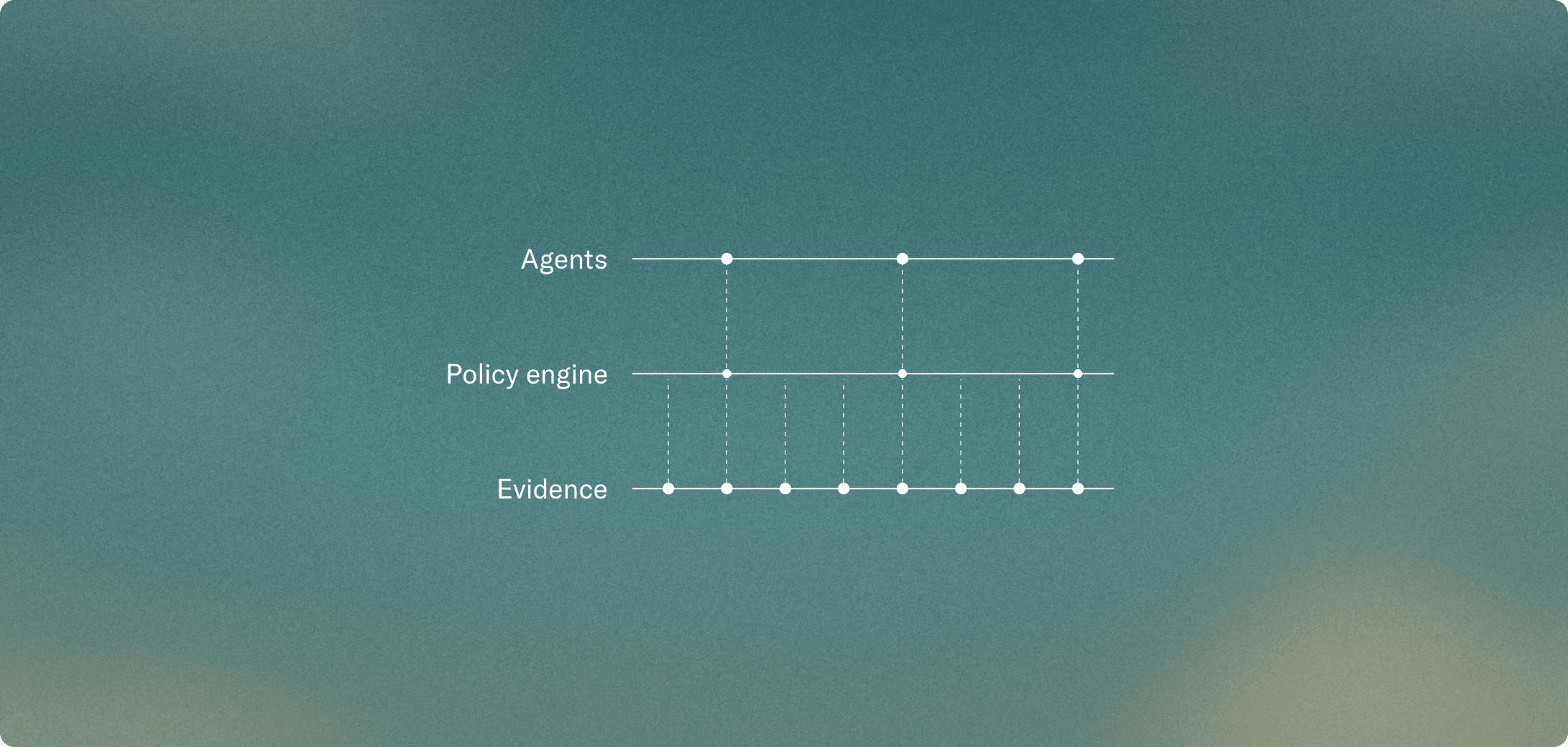
Building a bank-grade AI system involves more than selecting a language model. After the model generates a recommendation, the work shifts to the system around it. Every recommendation is traceable to the evidence behind it and the policy that guided the decision. As new evidence becomes available, the system explains why an assessment changed while preserving the full history of the customer relationship. Continuous evaluation helps ensure recommendations stay aligned with policy.
These capabilities are important because compliance deals with objective outcomes. A business either satisfies the bank’s policy or it doesn’t. The system has to determine what evidence is important and when a decision requires human judgment.
This is why bank-grade AI requires an entire system.The model contributes reasoning, while the surrounding system defines what good looks like, applies organizational policy, and continuously evaluates every decision against that standard.
Compliance as a competitive advantage
Compliance is part of every customer relationship. It affects which businesses are approved and how much friction gets introduced. Compliance also impacts the experience as customers add new products or go through re-KYC.
If someone is applying for a mortgage, it makes a difference whether they get an instant response, or have to wait a week for a representative to do the math and call them back. The customer experience is also impacted by how enterprises address the following questions:
How much information should we ask from the customer?
How quickly can we react?
How much can we tailor the experience?
Bank-grade AI helps teams ask less, react faster, and tailor the experience more precisely. It also makes it easier to expand into new geographies, because the same operating model can adapt to different local rules and evidence requirements, without starting over each time.
On the bottom line, bank-grade AI reduces the labor spent reviewing cases and helps avoid penalties. Duna customers have seen a 51% drop in follow-up rates.
Those gains make compliance a strategic part of how you grow, instead of something that slows you down.
“Operating a global business requires a deep understanding of local needs. Duna’s onboarding offers global growth and local nuance.” — Alexandre Prot, CEO & co-founder, Qonto
A higher standard for AI
Regulators and customers continue to expect more from financial institutions, so not just any AI will do. A purpose-built system gives banks the confidence to meet those expectations. That’s how compliance stops being a cost center and becomes a competitive advantage.
See how financial institutions use Duna to build explainable, auditable, and consistent AI into every business onboarding and compliance decision. Get in touch
Bank-grade AI is turning compliance into a competitive advantage.
Consumer banks like Revolut and Trade Republic changed what customers expect from financial services. They made the experience so easy and intuitive that traditional banks couldn’t keep up.
Today, Revolut serves more than 70 million customers worldwide, and nearly 1 in 3 newly opened bank accounts across six key European markets is a Revolut account. Trade Republic has grown to more than 10 million customers across Europe.
This is what it looks like when friction disappears. Business customers now expect the same experience, yet strict compliance requirements and manual processes slow things down. According to PwC, 90% of compliance leaders in financial services say compliance requirements have become more complex in the last three years.
AI can help financial institutions stay compliant while improving the customer experience, but only if it’s built for regulated environments.
Why general-purpose AI isn’t enough
In customer service, if AI gives a wrong answer or misroutes a call, it’s usually just an inconvenience. The customer gets frustrated and tries again.
In compliance, the stakes are much higher. AI is used in fraud review, onboarding, and regulator-facing decisions, so it has to meet a higher standard. If the output isn’t consistent or can’t be audited, it won’t hold up under regulatory review. For compliance professionals, AI errors could also carry personal accountability.
That’s why AI used in highly-regulated environments needs to be explainable, auditable, and repeatable.
Three principles of bank-grade AI
These characteristics are what separate AI that’s suitable for regulated decisions from AI built for general-purpose tasks.
1. Explainable: Show your work
Math teachers ask students to show their work so they can see the steps used to solve the problem. But some students leave the steps out and simply write the answer, leaving the teacher wondering if they really understood the problem or copied off the person next to them.
This is the same problem with simple AI agents. They give you answers but can’t explain how they got there.
Bank-grade AI helps teams and auditors understand the entire journey — from the data points used in the assessment to how they were evaluated and how the conclusion was drawn.
2. Auditable: Every decision is backed by evidence
A business onboarding application can collect information from multiple sources, including customer declarations and documents, government registries, and notaries. All of these sources have different levels of quality.
In addition to having access to this data, a bank-grade system needs to know which source to trust more and how to rate if there’s a discrepancy. For example, if the self-declaration is negative and the government source is positive, the mismatch is less of a problem. But if it’s the other way around, analysts might need to investigate further.
The same kind of evidence is needed during the assessment. If a customer self-declares one address, but the official registry, postal database, and even their ID show slightly different addresses, the system now has four versions of the same data point.
The agent needs a mechanism to decide which version it trusts or whether it should go back to the customer and ask for clarification. When AI is able to record how it got to the conclusion that a given address is the right one, teams can have more confidence in the assessment and in future similar situations.
“As a regulated bank, we’re held to the highest standards for compliance and security. Duna is a trusted partner we rely on daily to meet strict banking-grade requirements. With Duna’s platform, we confidently onboard and manage business customers from first interaction through the full customer lifecycle.”
— Bas van Beusekom, CCO, Brand New Day Bank
3. Repeatable: The same input leads to the same result
Most people have seen AI answer the same question twice and produce two different responses. That might be acceptable when brainstorming ideas or drafting an email, but not in compliance.
Business identity and Know Your Business (KYB) decisions can determine whether a customer relationship continues or not, so risk assessment should run continuously. If something changes, such as a new beneficial owner, a sanctions update, or a change in the company’s registration, it’s reasonable to expect the outcome to change.
But if a bank evaluates the same business using the same evidence, the system should reach the same conclusion every time. Otherwise, teams can’t trust the assessment or explain why one decision differed from another.
Just as compliance teams use training and quality assurance (QA) to make sure people evaluate cases consistently, a bank-grade AI system should do the same.
Reliable AI requires more than a model
Building a bank-grade AI system involves more than selecting a language model. After the model generates a recommendation, the work shifts to the system around it. Every recommendation is traceable to the evidence behind it and the policy that guided the decision. As new evidence becomes available, the system explains why an assessment changed while preserving the full history of the customer relationship. Continuous evaluation helps ensure recommendations stay aligned with policy.
These capabilities are important because compliance deals with objective outcomes. A business either satisfies the bank’s policy or it doesn’t. The system has to determine what evidence is important and when a decision requires human judgment.
This is why bank-grade AI requires an entire system.The model contributes reasoning, while the surrounding system defines what good looks like, applies organizational policy, and continuously evaluates every decision against that standard.
Compliance as a competitive advantage
Compliance is part of every customer relationship. It affects which businesses are approved and how much friction gets introduced. Compliance also impacts the experience as customers add new products or go through re-KYC.
If someone is applying for a mortgage, it makes a difference whether they get an instant response, or have to wait a week for a representative to do the math and call them back. The customer experience is also impacted by how enterprises address the following questions:
How much information should we ask from the customer?
How quickly can we react?
How much can we tailor the experience?
Bank-grade AI helps teams ask less, react faster, and tailor the experience more precisely. It also makes it easier to expand into new geographies, because the same operating model can adapt to different local rules and evidence requirements, without starting over each time.
On the bottom line, bank-grade AI reduces the labor spent reviewing cases and helps avoid penalties. Duna customers have seen a 51% drop in follow-up rates.
Those gains make compliance a strategic part of how you grow, instead of something that slows you down.
“Operating a global business requires a deep understanding of local needs. Duna’s onboarding offers global growth and local nuance.” — Alexandre Prot, CEO & co-founder, Qonto
A higher standard for AI
Regulators and customers continue to expect more from financial institutions, so not just any AI will do. A purpose-built system gives banks the confidence to meet those expectations. That’s how compliance stops being a cost center and becomes a competitive advantage.
See how financial institutions use Duna to build explainable, auditable, and consistent AI into every business onboarding and compliance decision. Get in touch
Continue reading




Industries
Customers
Company
Resources

Industries
Customers
Company
Resources
Industries
Customers
Company
Resources