What AI means for the future of the compliance profession


Duco van Lanschot
On this page
Compliance analysts are responsible for investigating risk and stopping fraud, but spend much of their time collecting documents and checking paperwork instead.
When onboarding business customers, analysts manually verify ownership structures, review screening results, and send multiple rounds of back-and-forth emails to resolve missing or inconsistent information. During reboarding, they repeat many of those same checks to confirm the customer’s risk profile is still accurate.
Errors in compliance processes have led to regulatory action, billions in financial penalties, and lost revenue when legitimate customers abandon the onboarding process. Research shows that 52% of customers abandon onboarding applications that take more than 10 minutes to complete (Ribbit Capital, Identity Newsletter). For compliance professionals at banks and fintechs, mistakes can also carry personal liability.
As regulatory requirements expand, an operating model built around manual reviews is becoming more difficult and expensive to maintain. Around one-third of financial institutions across EMEA expect Anti-Money Laundering (AML) compliance costs to increase by 10–30% over the next two years, reports PwC.
AI is shifting routine compliance work from analysts to software, allowing professionals to focus on higher-risk cases where human judgment provides the most value.
AI impacts compliance work at every level
AI changes every layer of the compliance function, from routine case reviews to team leadership. This is what compliance roles typically look like today.
First-line reviews: Analysts review onboarding cases, verify customer information, and complete routine investigations.
Second-line exceptions: Compliance specialists write rules, check to see if they’re followed, and decide risk levels for difficult cases.
Leadership: Compliance leaders determine how the function operates as the business grows, ensuring the team has the capacity and tools to identify risk effectively.
How roles are evolving
Analysts spend more time looking for patterns
AI shifts compliance work from 99% checkbox and 1% judgment to 99% judgment and 1% checkbox.
For example, a business customer submits an onboarding application, but ownership information is incomplete and supporting documents are missing. The analyst emails the customer for additional information, waits for a response, reviews the new documents, and follows up again until the application is complete.
By the time the case is ready for review, the analyst has already spent hours chasing information and manually comparing data points.
Most of that work doesn’t require human judgment and can be handled by AI. A policy-driven onboarding and compliance platform automatically requests and verifies missing information, applies company policy to straightforward cases, and escalates exceptions for review.
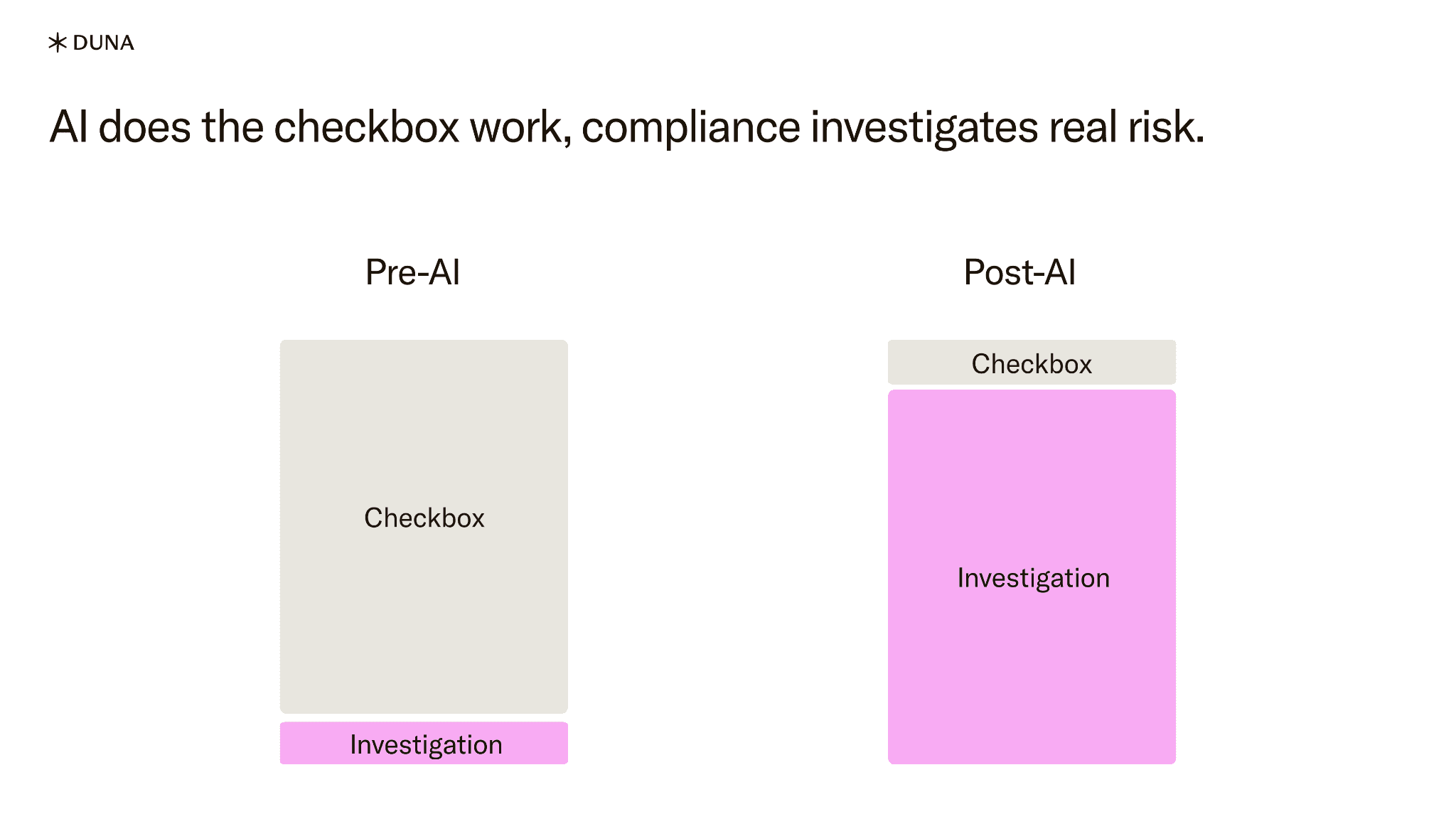
In organizations where AI can automate most routine onboarding reviews, first-line analysts may review only a small percentage of cases. In others, analysts spend more time identifying patterns, investigating anomalies, and escalating complex cases.
BCG found that false-positive rates can exceed 90%, meaning analysts spend a lot of their time reviewing cases that ultimately pose little or no risk. AI reduces that work, allowing analysts to focus on enhanced due diligence (EDD) investigations and Level 2 escalations that require human experience and judgment.
“62% of cases close first-time right with no follow-up. For a Customer Due Diligence (CDD) team, that is a quality signal. It tells us the policy is doing the work upstream, and the team can focus their judgment where it matters.”
— Head of CDD, European e-commerce platform
Every decision builds shared knowledge
AI helps enterprises capture case outcomes and reasoning, giving every reviewer access to the same knowledge for more consistent decision-making.
Let’s say most of your compliance team spends time verifying VAT numbers. Using the European Commission’s VIES VAT number validation system, one team member gathers additional information about the company that owns the number or the address it’s registered to. None of that new information matches the customer application.
Because this situation rarely occurs, your company doesn’t have written guidelines or policies that apply. The specialist makes a judgment call based on whether or not the discrepancy represents acceptable risk.
While the problem is solved for one customer, the next analyst who comes across a similar case has to start over.
AI agents apply previous reasoning and request additional evidence before a compliance expert gets involved. This allows the next analyst to build on earlier cases instead of solving the same problem again.
Experts improve the system
With every decision a compliance expert makes, they provide continuous feedback that improves how AI handles future cases. In some enterprises, AI agents take care of initial case assessment while compliance experts oversee the process. In others, AI helps specialists work more efficiently with human analysts who are managing complex cases.
For instance, rather than reading long briefs or having multiple meetings, experts can get Slack notifications from AI agents reporting on patterns from the team. Or they can get immediate context by asking the agent questions about what was decided in the past.
The role shifts from reviewing every case to improving how AI handles the next one.
Growth no longer depends on compliance headcount
As compliance volume grows, leaders traditionally respond by hiring more people. This increases costs and ties business growth directly to compliance headcount. McKinsey reports that banks typically allocate 10-15% of their full-time employees to KYC and Anti-Money Laundering (AML).
AI separates routine reviews from the investigations that require human judgment. That means growth no longer requires more analysts. Leaders can focus on improving the customer experience, refining policy, and supporting future business needs.
One Duna customer decreased drop-off rates by 37% and reduced follow-up cases by 53% without increasing compliance headcount.
“The main improvement with AI for us has been the automation. We don’t have to do the screening by ourselves anymore, so the reviews are faster and there are fewer manual tasks.”
— Compliance Analyst, European e-commerce platform
Human expertise becomes more valuable
Once basic screening tasks and manual reviews are automated, enterprises place greater value on the skills that AI can't replace.
According to PWC, executives say the following skills are most important to maintain effective compliance:
Specialist compliance, regulatory, legal, or risk expertise (53%)
Data management and analytics skills (43%)
Industry knowledge and business acumen (42%)
Expertise remains the foundation of an effective compliance function, even as AI changes how the work gets done.
A new operating model
The role of the compliance professional is changing. AI takes over predictable work, giving analysts, compliance specialists, and leaders more time to apply their expertise where judgment is required.
Each decision strengthens future decisions, creating a continuously improving operating model.
See how Duna helps banks and fintechs use AI to transform compliance from manual reviews into a policy-driven operating model. Read our AI Memo or get in touch.
Compliance analysts are responsible for investigating risk and stopping fraud, but spend much of their time collecting documents and checking paperwork instead.
When onboarding business customers, analysts manually verify ownership structures, review screening results, and send multiple rounds of back-and-forth emails to resolve missing or inconsistent information. During reboarding, they repeat many of those same checks to confirm the customer’s risk profile is still accurate.
Errors in compliance processes have led to regulatory action, billions in financial penalties, and lost revenue when legitimate customers abandon the onboarding process. Research shows that 52% of customers abandon onboarding applications that take more than 10 minutes to complete (Ribbit Capital, Identity Newsletter). For compliance professionals at banks and fintechs, mistakes can also carry personal liability.
As regulatory requirements expand, an operating model built around manual reviews is becoming more difficult and expensive to maintain. Around one-third of financial institutions across EMEA expect Anti-Money Laundering (AML) compliance costs to increase by 10–30% over the next two years, reports PwC.
AI is shifting routine compliance work from analysts to software, allowing professionals to focus on higher-risk cases where human judgment provides the most value.
AI impacts compliance work at every level
AI changes every layer of the compliance function, from routine case reviews to team leadership. This is what compliance roles typically look like today.
First-line reviews: Analysts review onboarding cases, verify customer information, and complete routine investigations.
Second-line exceptions: Compliance specialists write rules, check to see if they’re followed, and decide risk levels for difficult cases.
Leadership: Compliance leaders determine how the function operates as the business grows, ensuring the team has the capacity and tools to identify risk effectively.
How roles are evolving
Analysts spend more time looking for patterns
AI shifts compliance work from 99% checkbox and 1% judgment to 99% judgment and 1% checkbox.
For example, a business customer submits an onboarding application, but ownership information is incomplete and supporting documents are missing. The analyst emails the customer for additional information, waits for a response, reviews the new documents, and follows up again until the application is complete.
By the time the case is ready for review, the analyst has already spent hours chasing information and manually comparing data points.
Most of that work doesn’t require human judgment and can be handled by AI. A policy-driven onboarding and compliance platform automatically requests and verifies missing information, applies company policy to straightforward cases, and escalates exceptions for review.
In organizations where AI can automate most routine onboarding reviews, first-line analysts may review only a small percentage of cases. In others, analysts spend more time identifying patterns, investigating anomalies, and escalating complex cases.
BCG found that false-positive rates can exceed 90%, meaning analysts spend a lot of their time reviewing cases that ultimately pose little or no risk. AI reduces that work, allowing analysts to focus on enhanced due diligence (EDD) investigations and Level 2 escalations that require human experience and judgment.
“62% of cases close first-time right with no follow-up. For a Customer Due Diligence (CDD) team, that is a quality signal. It tells us the policy is doing the work upstream, and the team can focus their judgment where it matters.”
— Head of CDD, European e-commerce platform
Every decision builds shared knowledge
AI helps enterprises capture case outcomes and reasoning, giving every reviewer access to the same knowledge for more consistent decision-making.
Let’s say most of your compliance team spends time verifying VAT numbers. Using the European Commission’s VIES VAT number validation system, one team member gathers additional information about the company that owns the number or the address it’s registered to. None of that new information matches the customer application.
Because this situation rarely occurs, your company doesn’t have written guidelines or policies that apply. The specialist makes a judgment call based on whether or not the discrepancy represents acceptable risk.
While the problem is solved for one customer, the next analyst who comes across a similar case has to start over.
AI agents apply previous reasoning and request additional evidence before a compliance expert gets involved. This allows the next analyst to build on earlier cases instead of solving the same problem again.
Experts improve the system
With every decision a compliance expert makes, they provide continuous feedback that improves how AI handles future cases. In some enterprises, AI agents take care of initial case assessment while compliance experts oversee the process. In others, AI helps specialists work more efficiently with human analysts who are managing complex cases.
For instance, rather than reading long briefs or having multiple meetings, experts can get Slack notifications from AI agents reporting on patterns from the team. Or they can get immediate context by asking the agent questions about what was decided in the past.
The role shifts from reviewing every case to improving how AI handles the next one.
Growth no longer depends on compliance headcount
As compliance volume grows, leaders traditionally respond by hiring more people. This increases costs and ties business growth directly to compliance headcount. McKinsey reports that banks typically allocate 10-15% of their full-time employees to KYC and Anti-Money Laundering (AML).
AI separates routine reviews from the investigations that require human judgment. That means growth no longer requires more analysts. Leaders can focus on improving the customer experience, refining policy, and supporting future business needs.
One Duna customer decreased drop-off rates by 37% and reduced follow-up cases by 53% without increasing compliance headcount.
“The main improvement with AI for us has been the automation. We don’t have to do the screening by ourselves anymore, so the reviews are faster and there are fewer manual tasks.”
— Compliance Analyst, European e-commerce platform
Human expertise becomes more valuable
Once basic screening tasks and manual reviews are automated, enterprises place greater value on the skills that AI can't replace.
According to PWC, executives say the following skills are most important to maintain effective compliance:
Specialist compliance, regulatory, legal, or risk expertise (53%)
Data management and analytics skills (43%)
Industry knowledge and business acumen (42%)
Expertise remains the foundation of an effective compliance function, even as AI changes how the work gets done.
A new operating model
The role of the compliance professional is changing. AI takes over predictable work, giving analysts, compliance specialists, and leaders more time to apply their expertise where judgment is required.
Each decision strengthens future decisions, creating a continuously improving operating model.
See how Duna helps banks and fintechs use AI to transform compliance from manual reviews into a policy-driven operating model. Read our AI Memo or get in touch.
Continue reading




Industries
Customers
Company
Resources

Industries
Customers
Company
Resources
Industries
Customers
Company
Resources