Top AI Compliance Agents for EU Corporate Onboarding 2026

On this page
AI compliance agents for EU corporate onboarding: what "agent" means in KYB/KYC/AML
An AI compliance agent, in operational terms, is software that ingests company registry data and uploaded documents, maps ownership structures to identify ultimate beneficial owners (UBOs), executes KYB risk scoring logic, triggers AML screening, and outputs an audit-ready rationale with defined escalation points for human sign-off. That definition matters because the term "AI agent" is now attached to almost every compliance product on the market, making category precision essential for buyers.
"Top-rated" cannot be determined by marketing claims alone. The vendors that perform best in production EU deployments share specific, measurable capabilities: multi-jurisdiction registry coverage, reliable UBO resolution through layered entities, explainable risk scores, and decision trails that survive regulatory review. Vendor shortlisting without those criteria leads to failed pilots and replatforming costs.
The EU context raises the stakes further. According to Sumsub's European KYB Benchmark Survey 2026, slow, manual onboarding causes 81% of EU businesses to lose potential corporate clients, and 80% report slowed business growth as a direct consequence. Separate data from the same survey shows 59% of companies face direct customer drop-off during onboarding because of compliance complexity, and 53% report direct KYB fraud, predominantly via forged documents and fake identities. These are not edge-case risks. They represent the operating baseline that any serious AI compliance platform must address.
Shortlist framework: how to rank AI compliance agents for European KYB
Buyers evaluating AI compliance agents for European KYB need a scoring rubric built around what actually fails in production, not what looks good in a demo. Assess vendors across these eight dimensions:
EU KYB data coverage and localization. Does the platform connect to local company registries across the EU's 27+ jurisdictions? Superficial "global data" claims don't tell you whether a platform resolves a Dutch KvK entry, a German Handelsregister filing, or a Maltese MFSA record directly or through brittle third-party aggregation.
UBO mapping. Can the system resolve layered holding structures with multiple jurisdictions, nominee arrangements, and trust-based ownership? This is where shallow KYB solutions fail most often.
Document verification and fraud resistance. Automated document checks must detect forgeries and AI-generated fake identities, not just OCR-parse data fields. With 53% of EU firms reporting KYB fraud (Sumsub, July 2026), fraud resistance is a baseline requirement.
AML screening coverage. Sanctions, PEP, and adverse media screening must cover EU-relevant lists with configurable match thresholds. False-positive management is as important as coverage; some sources estimate AML alert false-positive rates at 90-95% in comparable deployments.
KYB risk scoring and periodic rechecks. Static onboarding-only scoring is insufficient. Continuous reassessment triggered by business changes, media events, or policy updates is what separates production-grade systems from pilots.
Audit trail quality. Every decision, data input, agent execution step, and human action must be logged and reproducible. Regulators and auditors require it; vendors that can't demonstrate it shouldn't reach procurement finals.
Integration architecture. REST APIs, webhook event streams, and data sync patterns determine real implementation timelines. A "single integration" pitch requires scrutiny: ask for the actual API documentation and supported webhook event catalog before committing.
Governance and human-in-the-loop controls. Agentic automation without defined escalation rules creates uncontrolled decisioning. Four-eye review workflows, case escalation logic, and policy-driven approval gates are non-negotiable for regulated institutions.
Questions to ask vendors during procurement
For compliance and risk teams: How does your platform handle EU UBO threshold variations (25% in most jurisdictions, but lower in some)? What is your false-positive management methodology for PEP and sanctions screening? How are policy changes versioned and applied to in-flight cases?
For engineering and integration teams: What does your webhook event catalog cover? What's the typical API response latency for registry lookups? Do you provide a sandbox environment with representative EU test data? What fallback procedures exist if a third-party data provider is unavailable?
For procurement: What certifications apply (SOC 2, ISO 27001, GDPR data processing agreements)? Where is data stored and processed? What is your SLA for uptime and support response?
A vendor that answers these questions with specific, documented evidence is production-ready. One that redirects to a sales demo is not.
The European KYB gap in 2026 (why agents are moving from pilot to production)
The statistics from Sumsub's July 2026 benchmark survey represent a structural problem, not a temporary friction point. When 81% of EU businesses lose corporate clients to onboarding delays, the gap isn't in regulatory intent, it's in execution infrastructure. Manual KYB processes create three compounding costs: analyst time spent on low-value data gathering, time-to-decision measured in days rather than minutes, and customer drop-off at rates that directly reduce revenue.
The 59% drop-off rate during onboarding due to compliance complexity maps to a specific operational failure: compliance programs that weren't designed with the customer journey in mind. When every corporate onboarding requires back-and-forth emails to collect UBO documentation, the friction accumulates at exactly the moment a new client should be activating.
Periodic recheck burden compounds this. Enterprises that onboarded clients three years ago now face re-KYC queues that their analyst teams can't clear at current headcount. This is where reboarding challenges in compliance have become as operationally significant as initial onboarding.
Agentic automation addresses this differently from document parsing tools or workflow automation alone. What distinguishes an AI agent from a rules-based workflow is the combination of orchestration logic, decision rationale generation, and auditability built into the same system. An agent that verifies a German GmbH, resolves the ownership graph, checks each UBO against PEP and sanctions lists, and writes an evidence-backed case narrative does in minutes what an analyst would spend hours on. But the value isn't just speed. It's that the output is reproducible, explainable, and defensible to a regulator.
Best-fit agent categories for EU corporate onboarding (and where each one wins)
AI compliance agents don't form a single category. Five distinct agent types map to different stages of the EU corporate onboarding workflow, and the strongest platforms combine all five under a unified policy layer.
Category 1: KYB document and registry verification agents. These agents query company registries directly, extract structured data from incorporation certificates, annual filings, and beneficial ownership registers, and cross-check for discrepancies. The core question is registry depth: a platform covering 210+ local registries handles the Handelsregister, Companies House, KvK, and Registre du Commerce et des Sociétés natively, not through a single aggregator with a 24-hour data lag.
Category 2: UBO and ownership mapping agents. Complex EU corporate structures often involve holding companies in Luxembourg, operational entities in the Netherlands, and UBOs registered in a third jurisdiction. A UBO mapping agent must traverse multi-hop ownership graphs, flag circular ownership patterns, and identify control structures that fall outside simple percentage thresholds. This is the most technically differentiated category among current vendors.
Category 3: KYB risk scoring and periodic recheck agents. Risk scoring at onboarding is table stakes. What differentiates production-grade platforms is continuous reassessment: agents that monitor for business attribute changes (revenue spikes, new legal representatives, changes in registered address), regulatory updates, or media events, and automatically trigger a recheck or re-KYC workflow when thresholds are crossed.
Category 4: AML screening orchestration agents. These agents run sanctions, PEP, and adverse media checks against each legal entity and identified UBO, but their real value lies in case context management. A hit on a common name means nothing without entity disambiguation, source corroboration, and a match rationale. Agents that produce an evidence-bundled alert rather than a raw match dramatically reduce analyst review time.
Category 5: Case management and audit-trail agents. The final category connects the prior four. These agents compile evidence bundles, write case narratives, route decisions to the appropriate review tier, and log every action taken. For regulated institutions, this is where compliance defensibility is built or broken.
Agentic onboarding in practice: an end-to-end EU corporate journey
A reference flow for EU corporate onboarding under an agentic model runs as follows:
1. Onboarding intake. The applicant enters basic entity details. Risk-based logic determines which additional data points are required before collection begins. Low-risk sole traders receive a minimal flow; complex multi-entity groups trigger extended ownership and document collection immediately.
2. Risk-based data collection. Adaptive journey logic shapes the frontend in real time based on risk signals assessed during intake. A company flagged as operating in a higher-risk jurisdiction receives additional document requests automatically, without analyst intervention. Duna Onboard's dynamic frontend and staged onboarding architecture handles this natively: data collection adapts based on product usage, entity type, and risk profile without requiring engineering changes for each new policy.
3. UBO mapping. The ownership mapping agent queries relevant registries, resolves the ownership graph, and identifies UBOs above the applicable threshold. Where the structure includes foreign holding companies, the agent expands the query scope and flags entities requiring additional investigation. Private interaction modules allow the platform to send authenticated document requests directly to UBOs for identity verification, source of funds, and contract signing, without the compliance team managing the communication separately.
4. KYB risk scoring. With registry data, ownership structure, and documents collected, the risk scoring agent applies the configured policy logic. This is where a policy engine adds the most value: risk thresholds, escalation rules, and data requirements are defined in code and versioned, so every case is processed against the same logic regardless of which analyst is on duty.
5. AML screening. Sanctions, PEP, and adverse media checks run against each identified entity and UBO. Match results are processed with entity disambiguation logic to reduce false positives, and any confirmed alerts are packaged with supporting evidence for analyst review.
6. Decision and audit trail. The case management agent compiles the complete evidence bundle, assigns the case to the appropriate review queue, and records the decision with full traceability. Four-eye review workflows apply where required. Every action taken, including automated agent steps and human overrides, is logged with timestamps and policy version references.
7. Periodic rechecks. Post-onboarding, the lifecycle compliance layer runs daily screening for PEP and sanctions changes, monitors for discrepancies in business attributes, and triggers re-KYC workflows when policy conditions are met. This removes the re-KYC backlog problem that manual programs accumulate over time.
Top picks by buyer need (positioned shortlist, not a blind ranking)
No single vendor dominates every agent category. The right shortlist depends on the buyer's primary compliance gap, existing integration architecture, and jurisdictional footprint. The following assessment is based on publicly available vendor positioning and documented capabilities as of 2026.
Dotfile, best for speed and UBO unwrapping in mid-market deployments.
Dotfile's KYB onboarding messaging leads with "From days to minutes" and highlights "Automated UBO Unwrapping," "Unified Risk Decisions," and "Global Data" through a single integration. Its Integration Studio concept reduces engineering lift for teams without complex multi-product compliance architectures. The limitation: public documentation is thin on EU jurisdiction-specific registry coverage, audit workflow specifics, and enterprise governance controls. It's a strong choice for companies prioritizing time-to-market over deep policy configurability.
spektr, best for configurable AI agent workflows with monitoring.
spektr positions its platform around an "agent builder," configurable processes, monitoring, and optimization. Its KYB onboarding product page claims company verification in seconds and unified data source management, with an AI agents section connecting automation to policy routing. The platform is strong on modular configuration and has a G2-rated customer proof set. The gap is in published integration architecture detail and EU-specific compliance depth, which makes enterprise procurement conversations harder without bespoke discovery.
Sumsub, best for combined KYB risk scoring and document verification at scale.
Sumsub's July 2026 launch of automated KYB risk scoring addresses the 81% client-loss problem its own survey identified. The platform covers KYB verification, identity document checks, and AML screening. In March 2026, Sumsub announced a strategic partnership with ComplyAdvantage to enhance AML screening using ComplyAdvantage's AI-native Mesh risk intelligence. This combination strengthens its AML data coverage substantially. Sumsub is better suited to teams that need a broad-coverage single platform than to enterprises requiring deep policy customization per product line.
ComplyAdvantage, best for AML screening data quality and sanctions/PEP coverage.
ComplyAdvantage's Mesh risk intelligence is AI-native and covers sanctions, PEP, and adverse media at a depth that generic AML screening often misses. As a standalone AML data and screening layer, it's a strong component in a modular compliance stack. Its partnership with Sumsub (announced March 2026) indicates integration-first positioning. Teams using ComplyAdvantage typically pair it with a KYB orchestration platform rather than using it as a standalone onboarding solution.
Veriff, best for document verification and biometric KYC within a KYB workflow.
Veriff positions its business verification capability as AI-driven KYB and document checks for regulatory compliance and fraud prevention. It's a strong choice for the identity verification step within a corporate onboarding flow, particularly where high-volume biometric checks on legal representatives or UBOs are required. Veriff is a component solution rather than a full KYB orchestration platform.
Certa, best for third-party risk management and vendor onboarding compliance.
Certa's AI agent platform covers KYC/KYB/AML workflows with policy-to-workflow orchestration, risk assessment, and auditable decisions. It's strong for organizations managing vendor and supplier onboarding alongside customer onboarding, where third-party risk management (TPRM) requirements overlap with KYB obligations.
Duna, best for enterprise EU corporate onboarding requiring deep localization, policy-driven decisions, and full lifecycle coverage.
Duna addresses the full agent capability stack in a single platform. Its coverage of 210+ local registries and UBO registers across EU jurisdictions is direct, not aggregated, which matters for data freshness and accuracy. The policy engine translates KYB, KYC, and AML requirements into versioned code, ensuring every case is decided on the same logic and every decision is reproducible for audit. Duna's AI agents cover document verification, periodic reviews, and automated acceptance, while the lifecycle compliance layer handles daily screening and re-KYC triggers automatically.
For enterprises that need multi-product onboarding with different compliance policies per product line, Duna's adaptive journey architecture and private interaction modules handle complexity that point solutions can't. Plaid's GM EMEA, Zak Lambert, noted that "business onboarding used to be a cost center for Plaid. Now it's a revenue driver thanks to Duna's intuitive onboarding flows, enterprise-grade UX and minimal engineering work." seQura's CEO, David Backstrom, cited Duna's white-labeled UX as foundational to their customer experience. Duna is also trusted by Moss and Bol.
The honest caveat: Duna is optimized for enterprises with complex, multi-jurisdiction EU compliance programs. Teams onboarding only in a single jurisdiction with a straightforward ownership structure may find lighter-weight tools sufficient for their current scale.
Enterprise readiness checklist (security, auditability, and governance)
Adopting an agentic compliance platform is a production infrastructure decision, not a software trial. Enterprises should verify the following before committing:
Audit logs. Every agent action, data input, risk score, decision, and human override must be logged with timestamps, policy version references, and actor identification. Ask for a sample audit log from a real deployment, not a screenshot of a UI.
Explainability. AI-assisted decisions must be reproducible. If an agent approves or declines an entity based on a risk score, the compliance team must be able to reconstruct the exact inputs and logic that produced that score. Unexplainable decisions are a regulatory enforcement risk.
Human sign-off controls. Production-grade agentic systems define escalation rules that route cases to human reviewers when risk thresholds are crossed, ownership complexity exceeds automated resolution capacity, or AML screening generates confirmed alerts. Automation without defined human gates creates liability.
Data handling and residency. EU enterprises processing personal data are subject to GDPR. Confirm where data is stored, whether data processing agreements are in place, and what cross-border transfer mechanisms apply.
Model governance. Ask vendors for their AI model update process. Does a model update require re-validation of your compliance logic? What change management process applies? What QA testing runs before a model update reaches production?
Evidence packaging. Regulators and auditors require complete case files. Confirm that the platform generates exportable evidence bundles containing all data inputs, agent outputs, screening results, and decision rationale for every case.
Fallback procedures. Third-party data provider outages happen. Ask for the platform's fallback architecture: which checks have redundant provider routing, which fail gracefully, and what the documented recovery procedure is.
A vendor that provides documented answers to all of the above, with runbooks and production monitoring evidence on request, meets the minimum bar for enterprise deployment.
Implementation timeline and time-to-value
Agentic compliance platforms require structured rollouts, not lift-and-shift migrations. A realistic phased approach for EU enterprise deployments runs across four stages:
Stage 1: Discovery and sandbox (weeks 1-4). Map current onboarding workflows, compliance policies, and integration dependencies. Establish a sandbox environment with representative EU test data. Identify the highest-friction points in the current analyst workflow and prioritize them as the first automation targets.
Stage 2: Journey mapping and policy configuration (weeks 3-8). Define the onboarding journeys per entity type, jurisdiction, and product line. Configure the policy engine with current compliance rules. For Duna deployments, this is a no-code process for most journey configuration; engineering effort concentrates on API integrations with existing CRM, core banking, or risk systems.
Stage 3: Integrations and pilot (weeks 6-12). Connect data sources, including local registry feeds, document verification providers, and AML screening services. Run a controlled pilot with a subset of real cases, with governance gates requiring human sign-off on all automated decisions. Monitor false-positive rates, review queue volumes, and time-to-decision against baseline.
Stage 4: Scale-up and lifecycle activation (weeks 10-16). Expand to full production volume. Activate daily screening and periodic recheck workflows. Establish monitoring dashboards for case throughput, analyst workload, and policy exception rates.
Deep localization, 7+ language support, and direct registry connections reduce the discovery and integration effort significantly compared to building multi-jurisdiction coverage independently. The no-code journey configuration means compliance teams can adjust onboarding flows without engineering queues, which is particularly valuable when regulatory requirements change mid-deployment.
EU-specific context: eIDAS 2.0 and the EUDI wallet
Enterprise compliance teams operating in the EU in 2026 need to be aware of how eIDAS 2.0 and the European Digital Identity (EUDI) wallet framework will affect KYB onboarding workflows. eIDAS 2.0 establishes a legal framework for cross-border digital identity verification, and the EUDI wallet is designed to carry verifiable credentials for both individuals and, eventually, business entities.
For KYB specifically, eIDAS 2.0-compatible flows will allow legal representatives and UBOs to present certified identity attributes from their national EUDI wallets rather than uploading physical documents. This changes the document verification agent's role: instead of parsing and cross-checking uploaded files, the agent validates digitally signed credential claims from a trusted issuer.
Platforms that have built their identity verification layer with open, API-based architectures are better positioned to incorporate EUDI wallet verification without architectural rebuilds. The same applies to AI-native KYB platforms that treat identity data as structured, reusable evidence rather than one-time document uploads.
FAQ: European corporate onboarding, KYB automation, and compliance agents
Do AI compliance agents replace human compliance teams?
No. The correct framing is that agents handle high-volume, rules-deterministic work (registry queries, document parsing, sanctions matching, risk score calculation) so that analysts can focus on cases that genuinely require judgment. Governance frameworks for agentic compliance require defined human sign-off at escalation points, particularly for complex ownership structures, confirmed AML alerts, and high-risk entity classifications. Accountability for compliance decisions remains with the regulated institution.
How is false-positive risk managed during KYB/AML screening?
False positives in AML screening are a documented industry problem; some estimates place the rate at 90-95% of alerts in comparable deployments. Production-grade platforms address this through entity disambiguation logic (matching against full entity profiles, not just name strings), configurable match thresholds, and case context that groups related alerts for analyst review rather than generating individual raw hits. Vendors should demonstrate their false-positive management methodology with data from comparable EU deployments, not theoretical descriptions.
Which jurisdictions and data sources matter most in the EU context?
Coverage requirements vary by institution, but the core EU registry set includes: Germany (Handelsregister), the Netherlands (KvK), France (Registre du Commerce et des Sociétés), the UK (Companies House, relevant for EEA-adjacent operations), Luxembourg (RCS), Ireland (CRO), and Spain (BORME). Beyond company registries, UBO registers, local tax authority data, and VAT validation are required for complete KYB. Platforms claiming "global data" should document which registries they query directly and which they access through aggregators, along with the data refresh frequency for each source.
How do periodic rechecks work operationally?
A periodic recheck (re-KYC) workflow is triggered either by a scheduled review cycle (typically annually or biannually, depending on risk rating) or by an event-based trigger: a change in registered business details, a new PEP or sanctions hit during daily screening, a significant revenue or ownership change, or an updated compliance policy that requires recollection of specific data. Automated re-KYC workflows send authenticated data requests to the relevant legal representatives or UBOs, collect the required information, re-run risk scoring and AML screening, and route the case for analyst sign-off where required. Teams that rely on manual re-KYC outreach via email accumulate backlogs that agentic systems eliminate.
What integration patterns are used, and what's the typical implementation effort?
Most production KYB platforms expose REST APIs for case creation, status updates, and data retrieval, plus webhook event streams for real-time notifications (case status changes, screening alerts, document requests). Integration effort depends on the complexity of the existing tech stack: platforms with no-code journey builders and pre-built data connectors reduce engineering time significantly compared to platforms that require custom API work for every data source. A well-architected deployment connecting to an existing CRM, document management system, and AML data provider typically completes core integration in four to eight weeks, with policy configuration and testing extending the timeline to twelve weeks for complex multi-jurisdiction programs. Ask vendors for a reference implementation scope from a comparable EU enterprise deployment before accepting a timeline estimate.
Everything you need, and more
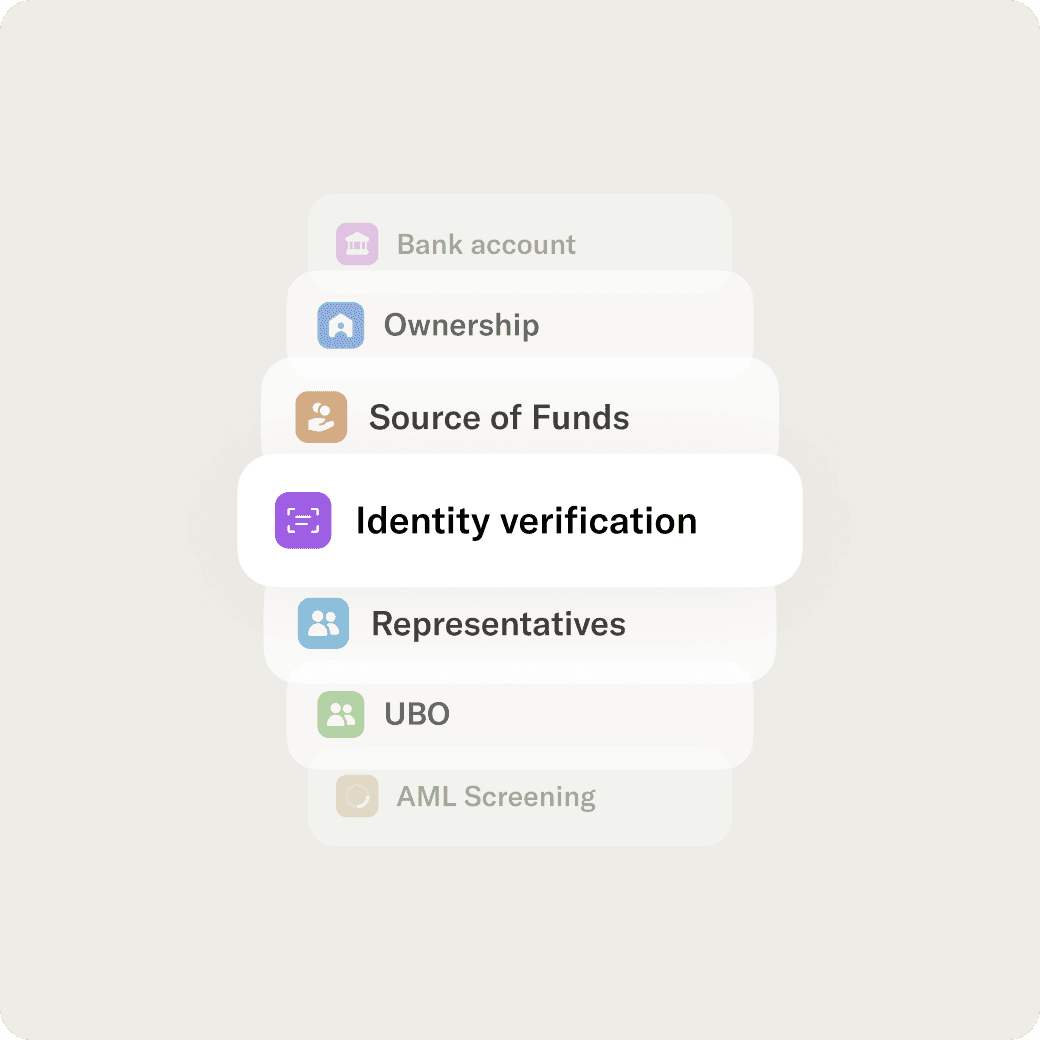
Access 20+ ready-made KYB modules, and fine-tune every data field to fit your enterprise needs.
Business details
Legal representatives
Ownership and UBO
AML screening
Ownership
Bank account
Proof of address
Terms and conditions
And more
Designed for conversion
We obsess over every detail of the onboarding flow, from UBO verification to the smallest animations. With Onboard, you have a team of engineers and designers working continually to increase sales on your behalf.
Third-party autofill
Existing data prefill
Real-time validation
Deep localization
Descriptive error messages
Multi-customer collaboration
Dynamic frontend
Data auto-completion
Onboard by link, phone, web
Smart reminders
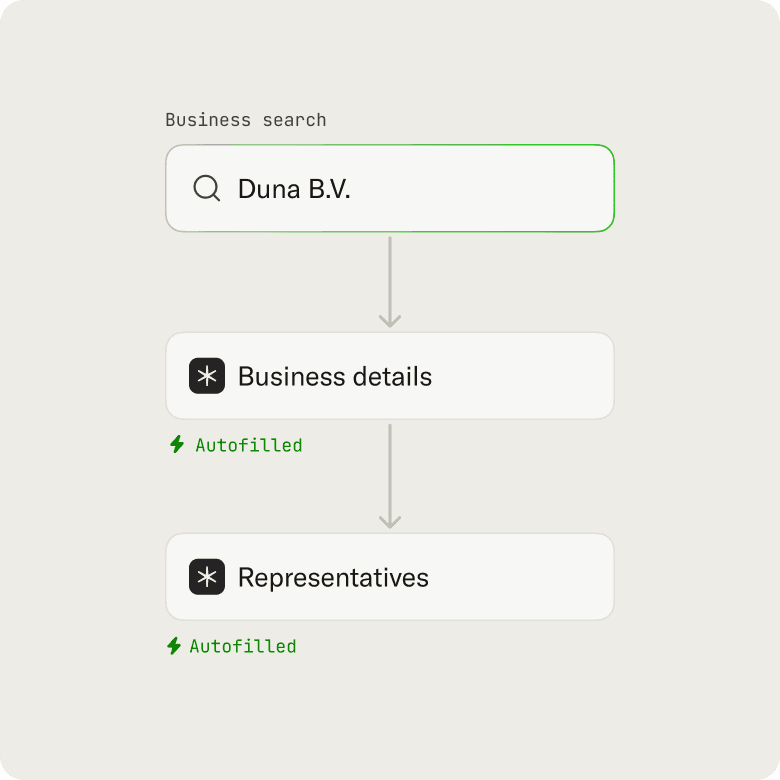
Collect all information in one go
Get the right data at the right time, without adding friction to your user experience.


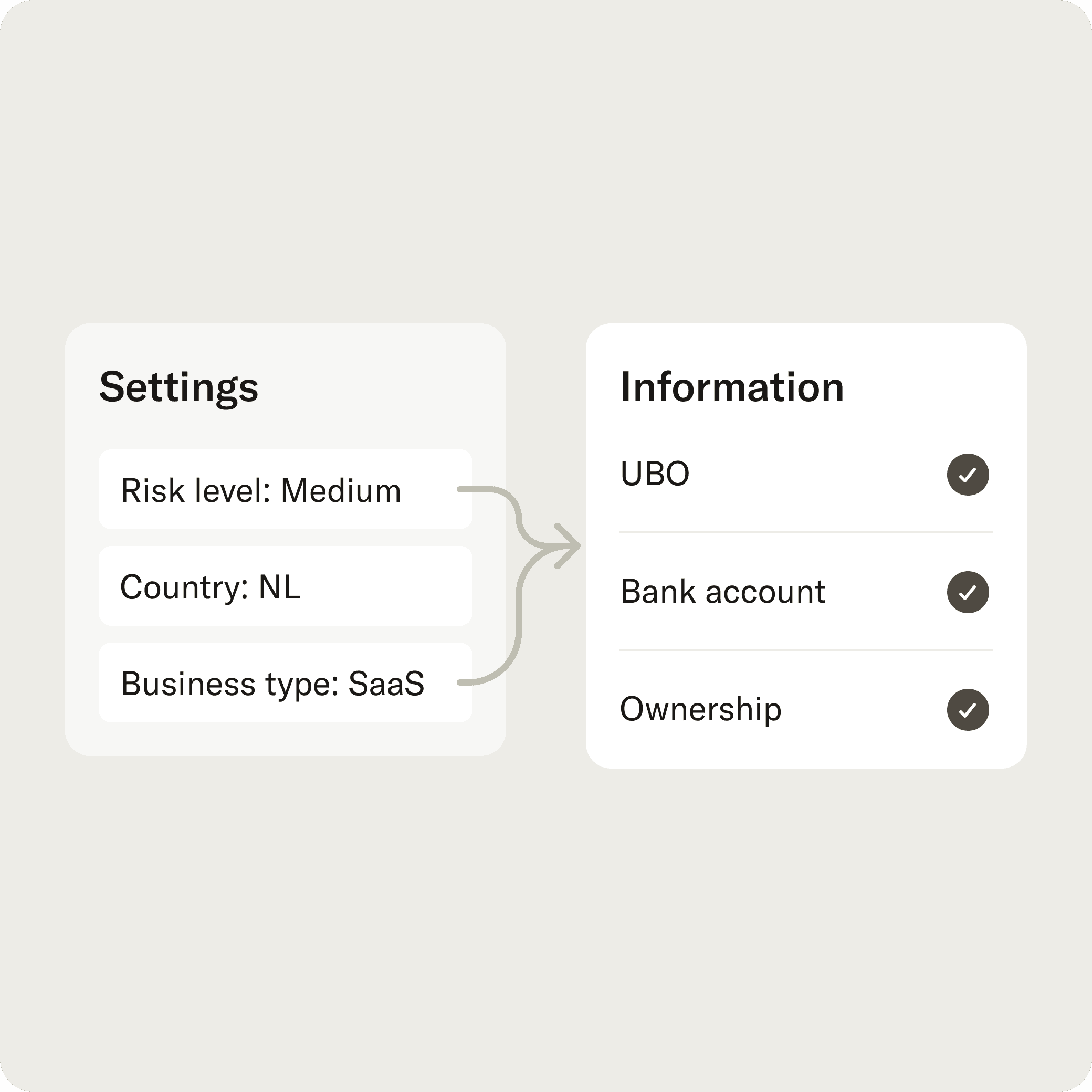
Adaptive journeys
Dynamically shape onboardings based on risk scoring, by assessing datapoints in real-time and adapting journeys automatically.
Staged onboarding
Avoid losing customers by asking basic information at account creation, and collecting additional KYC data based on product usage.
Private interactions
Create private interactions with legal representatives and UBOs to collect identity verification, source of funds, contract signatures, and more.
Multi-product onboarding
Onboard customers for multiple products with different compliance policies.
Fully customizable onboarding
Extensive white-labelling options let you customize colors, text, shapes, and brand settings to match your brand. Every touchpoint, including UBO verification flows and document request screens, carries your identity.

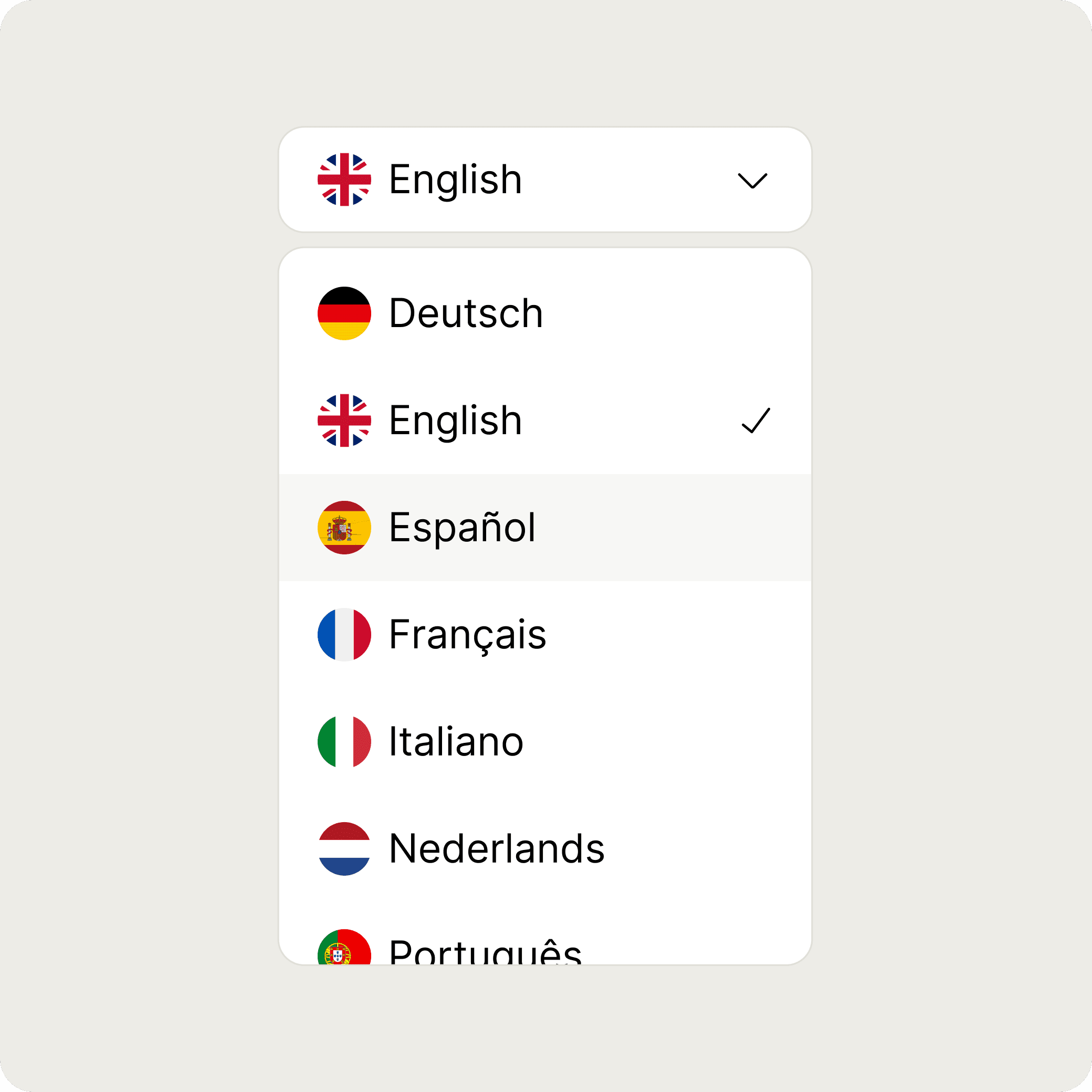
Global reach, local expertise
Navigate fragmented EU markets with 7+ languages and direct connections to 210+ local registries, KYC providers, UBO registers, tax ID collection, and more. Coverage is direct, not aggregated, which matters for data freshness and audit defensibility.
Explore data platform
Understand complex ownership structures
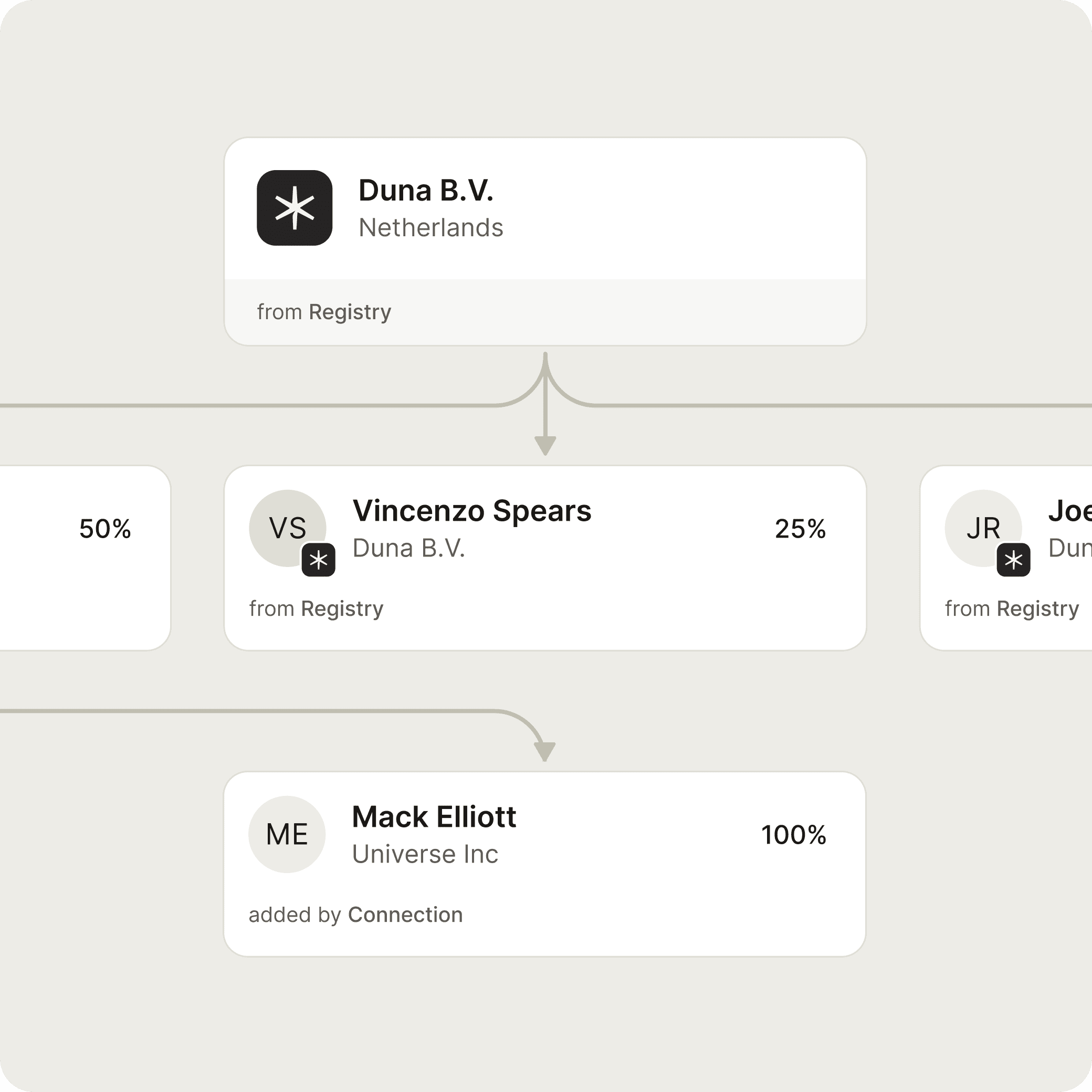
Map organizations with a multitude of representatives and legal entities, and collaborate with customers to obtain ownership and voting structures. The platform resolves multi-hop ownership graphs and flags control structures that fall outside simple percentage thresholds, which is where manual KYB processes most often break down.
"Great brands are built on great experiences. Duna's white-labeled UX makes our customer onboarding seamless."

David Backstrom
CEO, seQura
"Business onboarding used to be a cost center for Plaid. Now, it's a revenue driver thanks to Duna's intuitive onboarding flows, enterprise-grade UX and minimal engineering work."

Zak Lambert
GM EMEA, Plaid
Onboard at a glance
Modules
AML screening: PEP, sanctions, adverse media
ID document verification
Biometric verification
Bank account verification
IBAN validation
VAT validation
Proof of address
Terms and conditions
Email communication
Account sign-up
Electronic signature
Legal & contracting
Custom forms
Multi-channel
Onboard by Link
Direct sign-up
Staged onboarding
Dynamic onboarding
Multi-product onboarding
Multi-channel onboarding
Insights
Direct registry integrations
Local ID&V providers
7+ languages
Local UBO registers
Tax and VAT validation
Conversion
Third-party autofill
Existing data prefill
Real-time validation
Address and data auto-completion
Deep localization
Descriptive error messages
Multi-customer collaboration
Auto-save progress
Onboard by link, phone, web
Own-domain messaging
Smart reminders
Dynamic frontend
Collaboration
Private UBO sessions
Contracts and terms of service
Block list
Authenticated log-in
Activity logging
Next up
Lifecycle: Manage compliance throughout the customer lifecycle
Policy engine: Translate your regulatory programs into code
Data Platform: Unified KYC and data integrations
Get started
Learn more about the Duna platform. Enter your business email and we'll reach out.
Schedule a demo
AI compliance agents for EU corporate onboarding: what "agent" means in KYB/KYC/AML
An AI compliance agent, in operational terms, is software that ingests company registry data and uploaded documents, maps ownership structures to identify ultimate beneficial owners (UBOs), executes KYB risk scoring logic, triggers AML screening, and outputs an audit-ready rationale with defined escalation points for human sign-off. That definition matters because the term "AI agent" is now attached to almost every compliance product on the market, making category precision essential for buyers.
"Top-rated" cannot be determined by marketing claims alone. The vendors that perform best in production EU deployments share specific, measurable capabilities: multi-jurisdiction registry coverage, reliable UBO resolution through layered entities, explainable risk scores, and decision trails that survive regulatory review. Vendor shortlisting without those criteria leads to failed pilots and replatforming costs.
The EU context raises the stakes further. According to Sumsub's European KYB Benchmark Survey 2026, slow, manual onboarding causes 81% of EU businesses to lose potential corporate clients, and 80% report slowed business growth as a direct consequence. Separate data from the same survey shows 59% of companies face direct customer drop-off during onboarding because of compliance complexity, and 53% report direct KYB fraud, predominantly via forged documents and fake identities. These are not edge-case risks. They represent the operating baseline that any serious AI compliance platform must address.
Shortlist framework: how to rank AI compliance agents for European KYB
Buyers evaluating AI compliance agents for European KYB need a scoring rubric built around what actually fails in production, not what looks good in a demo. Assess vendors across these eight dimensions:
EU KYB data coverage and localization. Does the platform connect to local company registries across the EU's 27+ jurisdictions? Superficial "global data" claims don't tell you whether a platform resolves a Dutch KvK entry, a German Handelsregister filing, or a Maltese MFSA record directly or through brittle third-party aggregation.
UBO mapping. Can the system resolve layered holding structures with multiple jurisdictions, nominee arrangements, and trust-based ownership? This is where shallow KYB solutions fail most often.
Document verification and fraud resistance. Automated document checks must detect forgeries and AI-generated fake identities, not just OCR-parse data fields. With 53% of EU firms reporting KYB fraud (Sumsub, July 2026), fraud resistance is a baseline requirement.
AML screening coverage. Sanctions, PEP, and adverse media screening must cover EU-relevant lists with configurable match thresholds. False-positive management is as important as coverage; some sources estimate AML alert false-positive rates at 90-95% in comparable deployments.
KYB risk scoring and periodic rechecks. Static onboarding-only scoring is insufficient. Continuous reassessment triggered by business changes, media events, or policy updates is what separates production-grade systems from pilots.
Audit trail quality. Every decision, data input, agent execution step, and human action must be logged and reproducible. Regulators and auditors require it; vendors that can't demonstrate it shouldn't reach procurement finals.
Integration architecture. REST APIs, webhook event streams, and data sync patterns determine real implementation timelines. A "single integration" pitch requires scrutiny: ask for the actual API documentation and supported webhook event catalog before committing.
Governance and human-in-the-loop controls. Agentic automation without defined escalation rules creates uncontrolled decisioning. Four-eye review workflows, case escalation logic, and policy-driven approval gates are non-negotiable for regulated institutions.
Questions to ask vendors during procurement
For compliance and risk teams: How does your platform handle EU UBO threshold variations (25% in most jurisdictions, but lower in some)? What is your false-positive management methodology for PEP and sanctions screening? How are policy changes versioned and applied to in-flight cases?
For engineering and integration teams: What does your webhook event catalog cover? What's the typical API response latency for registry lookups? Do you provide a sandbox environment with representative EU test data? What fallback procedures exist if a third-party data provider is unavailable?
For procurement: What certifications apply (SOC 2, ISO 27001, GDPR data processing agreements)? Where is data stored and processed? What is your SLA for uptime and support response?
A vendor that answers these questions with specific, documented evidence is production-ready. One that redirects to a sales demo is not.
The European KYB gap in 2026 (why agents are moving from pilot to production)
The statistics from Sumsub's July 2026 benchmark survey represent a structural problem, not a temporary friction point. When 81% of EU businesses lose corporate clients to onboarding delays, the gap isn't in regulatory intent, it's in execution infrastructure. Manual KYB processes create three compounding costs: analyst time spent on low-value data gathering, time-to-decision measured in days rather than minutes, and customer drop-off at rates that directly reduce revenue.
The 59% drop-off rate during onboarding due to compliance complexity maps to a specific operational failure: compliance programs that weren't designed with the customer journey in mind. When every corporate onboarding requires back-and-forth emails to collect UBO documentation, the friction accumulates at exactly the moment a new client should be activating.
Periodic recheck burden compounds this. Enterprises that onboarded clients three years ago now face re-KYC queues that their analyst teams can't clear at current headcount. This is where reboarding challenges in compliance have become as operationally significant as initial onboarding.
Agentic automation addresses this differently from document parsing tools or workflow automation alone. What distinguishes an AI agent from a rules-based workflow is the combination of orchestration logic, decision rationale generation, and auditability built into the same system. An agent that verifies a German GmbH, resolves the ownership graph, checks each UBO against PEP and sanctions lists, and writes an evidence-backed case narrative does in minutes what an analyst would spend hours on. But the value isn't just speed. It's that the output is reproducible, explainable, and defensible to a regulator.
Best-fit agent categories for EU corporate onboarding (and where each one wins)
AI compliance agents don't form a single category. Five distinct agent types map to different stages of the EU corporate onboarding workflow, and the strongest platforms combine all five under a unified policy layer.
Category 1: KYB document and registry verification agents. These agents query company registries directly, extract structured data from incorporation certificates, annual filings, and beneficial ownership registers, and cross-check for discrepancies. The core question is registry depth: a platform covering 210+ local registries handles the Handelsregister, Companies House, KvK, and Registre du Commerce et des Sociétés natively, not through a single aggregator with a 24-hour data lag.
Category 2: UBO and ownership mapping agents. Complex EU corporate structures often involve holding companies in Luxembourg, operational entities in the Netherlands, and UBOs registered in a third jurisdiction. A UBO mapping agent must traverse multi-hop ownership graphs, flag circular ownership patterns, and identify control structures that fall outside simple percentage thresholds. This is the most technically differentiated category among current vendors.
Category 3: KYB risk scoring and periodic recheck agents. Risk scoring at onboarding is table stakes. What differentiates production-grade platforms is continuous reassessment: agents that monitor for business attribute changes (revenue spikes, new legal representatives, changes in registered address), regulatory updates, or media events, and automatically trigger a recheck or re-KYC workflow when thresholds are crossed.
Category 4: AML screening orchestration agents. These agents run sanctions, PEP, and adverse media checks against each legal entity and identified UBO, but their real value lies in case context management. A hit on a common name means nothing without entity disambiguation, source corroboration, and a match rationale. Agents that produce an evidence-bundled alert rather than a raw match dramatically reduce analyst review time.
Category 5: Case management and audit-trail agents. The final category connects the prior four. These agents compile evidence bundles, write case narratives, route decisions to the appropriate review tier, and log every action taken. For regulated institutions, this is where compliance defensibility is built or broken.
Agentic onboarding in practice: an end-to-end EU corporate journey
A reference flow for EU corporate onboarding under an agentic model runs as follows:
1. Onboarding intake. The applicant enters basic entity details. Risk-based logic determines which additional data points are required before collection begins. Low-risk sole traders receive a minimal flow; complex multi-entity groups trigger extended ownership and document collection immediately.
2. Risk-based data collection. Adaptive journey logic shapes the frontend in real time based on risk signals assessed during intake. A company flagged as operating in a higher-risk jurisdiction receives additional document requests automatically, without analyst intervention. Duna Onboard's dynamic frontend and staged onboarding architecture handles this natively: data collection adapts based on product usage, entity type, and risk profile without requiring engineering changes for each new policy.
3. UBO mapping. The ownership mapping agent queries relevant registries, resolves the ownership graph, and identifies UBOs above the applicable threshold. Where the structure includes foreign holding companies, the agent expands the query scope and flags entities requiring additional investigation. Private interaction modules allow the platform to send authenticated document requests directly to UBOs for identity verification, source of funds, and contract signing, without the compliance team managing the communication separately.
4. KYB risk scoring. With registry data, ownership structure, and documents collected, the risk scoring agent applies the configured policy logic. This is where a policy engine adds the most value: risk thresholds, escalation rules, and data requirements are defined in code and versioned, so every case is processed against the same logic regardless of which analyst is on duty.
5. AML screening. Sanctions, PEP, and adverse media checks run against each identified entity and UBO. Match results are processed with entity disambiguation logic to reduce false positives, and any confirmed alerts are packaged with supporting evidence for analyst review.
6. Decision and audit trail. The case management agent compiles the complete evidence bundle, assigns the case to the appropriate review queue, and records the decision with full traceability. Four-eye review workflows apply where required. Every action taken, including automated agent steps and human overrides, is logged with timestamps and policy version references.
7. Periodic rechecks. Post-onboarding, the lifecycle compliance layer runs daily screening for PEP and sanctions changes, monitors for discrepancies in business attributes, and triggers re-KYC workflows when policy conditions are met. This removes the re-KYC backlog problem that manual programs accumulate over time.
Top picks by buyer need (positioned shortlist, not a blind ranking)
No single vendor dominates every agent category. The right shortlist depends on the buyer's primary compliance gap, existing integration architecture, and jurisdictional footprint. The following assessment is based on publicly available vendor positioning and documented capabilities as of 2026.
Dotfile, best for speed and UBO unwrapping in mid-market deployments.
Dotfile's KYB onboarding messaging leads with "From days to minutes" and highlights "Automated UBO Unwrapping," "Unified Risk Decisions," and "Global Data" through a single integration. Its Integration Studio concept reduces engineering lift for teams without complex multi-product compliance architectures. The limitation: public documentation is thin on EU jurisdiction-specific registry coverage, audit workflow specifics, and enterprise governance controls. It's a strong choice for companies prioritizing time-to-market over deep policy configurability.
spektr, best for configurable AI agent workflows with monitoring.
spektr positions its platform around an "agent builder," configurable processes, monitoring, and optimization. Its KYB onboarding product page claims company verification in seconds and unified data source management, with an AI agents section connecting automation to policy routing. The platform is strong on modular configuration and has a G2-rated customer proof set. The gap is in published integration architecture detail and EU-specific compliance depth, which makes enterprise procurement conversations harder without bespoke discovery.
Sumsub, best for combined KYB risk scoring and document verification at scale.
Sumsub's July 2026 launch of automated KYB risk scoring addresses the 81% client-loss problem its own survey identified. The platform covers KYB verification, identity document checks, and AML screening. In March 2026, Sumsub announced a strategic partnership with ComplyAdvantage to enhance AML screening using ComplyAdvantage's AI-native Mesh risk intelligence. This combination strengthens its AML data coverage substantially. Sumsub is better suited to teams that need a broad-coverage single platform than to enterprises requiring deep policy customization per product line.
ComplyAdvantage, best for AML screening data quality and sanctions/PEP coverage.
ComplyAdvantage's Mesh risk intelligence is AI-native and covers sanctions, PEP, and adverse media at a depth that generic AML screening often misses. As a standalone AML data and screening layer, it's a strong component in a modular compliance stack. Its partnership with Sumsub (announced March 2026) indicates integration-first positioning. Teams using ComplyAdvantage typically pair it with a KYB orchestration platform rather than using it as a standalone onboarding solution.
Veriff, best for document verification and biometric KYC within a KYB workflow.
Veriff positions its business verification capability as AI-driven KYB and document checks for regulatory compliance and fraud prevention. It's a strong choice for the identity verification step within a corporate onboarding flow, particularly where high-volume biometric checks on legal representatives or UBOs are required. Veriff is a component solution rather than a full KYB orchestration platform.
Certa, best for third-party risk management and vendor onboarding compliance.
Certa's AI agent platform covers KYC/KYB/AML workflows with policy-to-workflow orchestration, risk assessment, and auditable decisions. It's strong for organizations managing vendor and supplier onboarding alongside customer onboarding, where third-party risk management (TPRM) requirements overlap with KYB obligations.
Duna, best for enterprise EU corporate onboarding requiring deep localization, policy-driven decisions, and full lifecycle coverage.
Duna addresses the full agent capability stack in a single platform. Its coverage of 210+ local registries and UBO registers across EU jurisdictions is direct, not aggregated, which matters for data freshness and accuracy. The policy engine translates KYB, KYC, and AML requirements into versioned code, ensuring every case is decided on the same logic and every decision is reproducible for audit. Duna's AI agents cover document verification, periodic reviews, and automated acceptance, while the lifecycle compliance layer handles daily screening and re-KYC triggers automatically.
For enterprises that need multi-product onboarding with different compliance policies per product line, Duna's adaptive journey architecture and private interaction modules handle complexity that point solutions can't. Plaid's GM EMEA, Zak Lambert, noted that "business onboarding used to be a cost center for Plaid. Now it's a revenue driver thanks to Duna's intuitive onboarding flows, enterprise-grade UX and minimal engineering work." seQura's CEO, David Backstrom, cited Duna's white-labeled UX as foundational to their customer experience. Duna is also trusted by Moss and Bol.
The honest caveat: Duna is optimized for enterprises with complex, multi-jurisdiction EU compliance programs. Teams onboarding only in a single jurisdiction with a straightforward ownership structure may find lighter-weight tools sufficient for their current scale.
Enterprise readiness checklist (security, auditability, and governance)
Adopting an agentic compliance platform is a production infrastructure decision, not a software trial. Enterprises should verify the following before committing:
Audit logs. Every agent action, data input, risk score, decision, and human override must be logged with timestamps, policy version references, and actor identification. Ask for a sample audit log from a real deployment, not a screenshot of a UI.
Explainability. AI-assisted decisions must be reproducible. If an agent approves or declines an entity based on a risk score, the compliance team must be able to reconstruct the exact inputs and logic that produced that score. Unexplainable decisions are a regulatory enforcement risk.
Human sign-off controls. Production-grade agentic systems define escalation rules that route cases to human reviewers when risk thresholds are crossed, ownership complexity exceeds automated resolution capacity, or AML screening generates confirmed alerts. Automation without defined human gates creates liability.
Data handling and residency. EU enterprises processing personal data are subject to GDPR. Confirm where data is stored, whether data processing agreements are in place, and what cross-border transfer mechanisms apply.
Model governance. Ask vendors for their AI model update process. Does a model update require re-validation of your compliance logic? What change management process applies? What QA testing runs before a model update reaches production?
Evidence packaging. Regulators and auditors require complete case files. Confirm that the platform generates exportable evidence bundles containing all data inputs, agent outputs, screening results, and decision rationale for every case.
Fallback procedures. Third-party data provider outages happen. Ask for the platform's fallback architecture: which checks have redundant provider routing, which fail gracefully, and what the documented recovery procedure is.
A vendor that provides documented answers to all of the above, with runbooks and production monitoring evidence on request, meets the minimum bar for enterprise deployment.
Implementation timeline and time-to-value
Agentic compliance platforms require structured rollouts, not lift-and-shift migrations. A realistic phased approach for EU enterprise deployments runs across four stages:
Stage 1: Discovery and sandbox (weeks 1-4). Map current onboarding workflows, compliance policies, and integration dependencies. Establish a sandbox environment with representative EU test data. Identify the highest-friction points in the current analyst workflow and prioritize them as the first automation targets.
Stage 2: Journey mapping and policy configuration (weeks 3-8). Define the onboarding journeys per entity type, jurisdiction, and product line. Configure the policy engine with current compliance rules. For Duna deployments, this is a no-code process for most journey configuration; engineering effort concentrates on API integrations with existing CRM, core banking, or risk systems.
Stage 3: Integrations and pilot (weeks 6-12). Connect data sources, including local registry feeds, document verification providers, and AML screening services. Run a controlled pilot with a subset of real cases, with governance gates requiring human sign-off on all automated decisions. Monitor false-positive rates, review queue volumes, and time-to-decision against baseline.
Stage 4: Scale-up and lifecycle activation (weeks 10-16). Expand to full production volume. Activate daily screening and periodic recheck workflows. Establish monitoring dashboards for case throughput, analyst workload, and policy exception rates.
Deep localization, 7+ language support, and direct registry connections reduce the discovery and integration effort significantly compared to building multi-jurisdiction coverage independently. The no-code journey configuration means compliance teams can adjust onboarding flows without engineering queues, which is particularly valuable when regulatory requirements change mid-deployment.
EU-specific context: eIDAS 2.0 and the EUDI wallet
Enterprise compliance teams operating in the EU in 2026 need to be aware of how eIDAS 2.0 and the European Digital Identity (EUDI) wallet framework will affect KYB onboarding workflows. eIDAS 2.0 establishes a legal framework for cross-border digital identity verification, and the EUDI wallet is designed to carry verifiable credentials for both individuals and, eventually, business entities.
For KYB specifically, eIDAS 2.0-compatible flows will allow legal representatives and UBOs to present certified identity attributes from their national EUDI wallets rather than uploading physical documents. This changes the document verification agent's role: instead of parsing and cross-checking uploaded files, the agent validates digitally signed credential claims from a trusted issuer.
Platforms that have built their identity verification layer with open, API-based architectures are better positioned to incorporate EUDI wallet verification without architectural rebuilds. The same applies to AI-native KYB platforms that treat identity data as structured, reusable evidence rather than one-time document uploads.
FAQ: European corporate onboarding, KYB automation, and compliance agents
Do AI compliance agents replace human compliance teams?
No. The correct framing is that agents handle high-volume, rules-deterministic work (registry queries, document parsing, sanctions matching, risk score calculation) so that analysts can focus on cases that genuinely require judgment. Governance frameworks for agentic compliance require defined human sign-off at escalation points, particularly for complex ownership structures, confirmed AML alerts, and high-risk entity classifications. Accountability for compliance decisions remains with the regulated institution.
How is false-positive risk managed during KYB/AML screening?
False positives in AML screening are a documented industry problem; some estimates place the rate at 90-95% of alerts in comparable deployments. Production-grade platforms address this through entity disambiguation logic (matching against full entity profiles, not just name strings), configurable match thresholds, and case context that groups related alerts for analyst review rather than generating individual raw hits. Vendors should demonstrate their false-positive management methodology with data from comparable EU deployments, not theoretical descriptions.
Which jurisdictions and data sources matter most in the EU context?
Coverage requirements vary by institution, but the core EU registry set includes: Germany (Handelsregister), the Netherlands (KvK), France (Registre du Commerce et des Sociétés), the UK (Companies House, relevant for EEA-adjacent operations), Luxembourg (RCS), Ireland (CRO), and Spain (BORME). Beyond company registries, UBO registers, local tax authority data, and VAT validation are required for complete KYB. Platforms claiming "global data" should document which registries they query directly and which they access through aggregators, along with the data refresh frequency for each source.
How do periodic rechecks work operationally?
A periodic recheck (re-KYC) workflow is triggered either by a scheduled review cycle (typically annually or biannually, depending on risk rating) or by an event-based trigger: a change in registered business details, a new PEP or sanctions hit during daily screening, a significant revenue or ownership change, or an updated compliance policy that requires recollection of specific data. Automated re-KYC workflows send authenticated data requests to the relevant legal representatives or UBOs, collect the required information, re-run risk scoring and AML screening, and route the case for analyst sign-off where required. Teams that rely on manual re-KYC outreach via email accumulate backlogs that agentic systems eliminate.
What integration patterns are used, and what's the typical implementation effort?
Most production KYB platforms expose REST APIs for case creation, status updates, and data retrieval, plus webhook event streams for real-time notifications (case status changes, screening alerts, document requests). Integration effort depends on the complexity of the existing tech stack: platforms with no-code journey builders and pre-built data connectors reduce engineering time significantly compared to platforms that require custom API work for every data source. A well-architected deployment connecting to an existing CRM, document management system, and AML data provider typically completes core integration in four to eight weeks, with policy configuration and testing extending the timeline to twelve weeks for complex multi-jurisdiction programs. Ask vendors for a reference implementation scope from a comparable EU enterprise deployment before accepting a timeline estimate.
Everything you need, and more
Access 20+ ready-made KYB modules, and fine-tune every data field to fit your enterprise needs.
Business details
Legal representatives
Ownership and UBO
AML screening
Ownership
Bank account
Proof of address
Terms and conditions
And more
Designed for conversion
We obsess over every detail of the onboarding flow, from UBO verification to the smallest animations. With Onboard, you have a team of engineers and designers working continually to increase sales on your behalf.
Third-party autofill
Existing data prefill
Real-time validation
Deep localization
Descriptive error messages
Multi-customer collaboration
Dynamic frontend
Data auto-completion
Onboard by link, phone, web
Smart reminders
Collect all information in one go
Get the right data at the right time, without adding friction to your user experience.
Adaptive journeys
Dynamically shape onboardings based on risk scoring, by assessing datapoints in real-time and adapting journeys automatically.
Staged onboarding
Avoid losing customers by asking basic information at account creation, and collecting additional KYC data based on product usage.
Private interactions
Create private interactions with legal representatives and UBOs to collect identity verification, source of funds, contract signatures, and more.
Multi-product onboarding
Onboard customers for multiple products with different compliance policies.
Fully customizable onboarding
Extensive white-labelling options let you customize colors, text, shapes, and brand settings to match your brand. Every touchpoint, including UBO verification flows and document request screens, carries your identity.
Global reach, local expertise
Navigate fragmented EU markets with 7+ languages and direct connections to 210+ local registries, KYC providers, UBO registers, tax ID collection, and more. Coverage is direct, not aggregated, which matters for data freshness and audit defensibility.
Explore data platform
Understand complex ownership structures
Map organizations with a multitude of representatives and legal entities, and collaborate with customers to obtain ownership and voting structures. The platform resolves multi-hop ownership graphs and flags control structures that fall outside simple percentage thresholds, which is where manual KYB processes most often break down.
"Great brands are built on great experiences. Duna's white-labeled UX makes our customer onboarding seamless."
David Backstrom
CEO, seQura
"Business onboarding used to be a cost center for Plaid. Now, it's a revenue driver thanks to Duna's intuitive onboarding flows, enterprise-grade UX and minimal engineering work."
Zak Lambert
GM EMEA, Plaid
Onboard at a glance
Modules
AML screening: PEP, sanctions, adverse media
ID document verification
Biometric verification
Bank account verification
IBAN validation
VAT validation
Proof of address
Terms and conditions
Email communication
Account sign-up
Electronic signature
Legal & contracting
Custom forms
Multi-channel
Onboard by Link
Direct sign-up
Staged onboarding
Dynamic onboarding
Multi-product onboarding
Multi-channel onboarding
Insights
Direct registry integrations
Local ID&V providers
7+ languages
Local UBO registers
Tax and VAT validation
Conversion
Third-party autofill
Existing data prefill
Real-time validation
Address and data auto-completion
Deep localization
Descriptive error messages
Multi-customer collaboration
Auto-save progress
Onboard by link, phone, web
Own-domain messaging
Smart reminders
Dynamic frontend
Collaboration
Private UBO sessions
Contracts and terms of service
Block list
Authenticated log-in
Activity logging
Next up
Lifecycle: Manage compliance throughout the customer lifecycle
Policy engine: Translate your regulatory programs into code
Data Platform: Unified KYC and data integrations
Get started
Learn more about the Duna platform. Enter your business email and we'll reach out.
Schedule a demo
Continue reading





Industries
Customers
Company
Resources

Industries
Customers
Company
Resources
Industries
Customers
Company
Resources